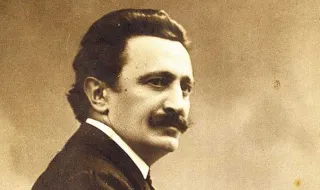
When writing about his own life, Branislav Nušić does not begin with a solemn date, but with a joke. In “Autobiography“ he notes: “After marriage, one no longer has an autobiography.“ Thus, in the very first lines, he shows how he will tell about himself – with a smile, self-irony and a slight suspicion of any official biography.
Nušić was born on October 20, 1864 in Belgrade with the name Alkibiad Nuša. Later, at the age of 18, he legally adopted the name Branislav Nušić. His childhood passed in Smederevo, after the family moved there. He graduated from the Great School in Belgrade with a degree in law, but his professional path turned out to be much more diverse than a bureaucratic career. He was a writer, journalist, diplomat, theater director, and academic.
His first encounter with power was in a poem
In 1885, Nušić participated in the Serbo-Bulgarian War. After it, he published the satirical poem "Two Slaves", directed against the political order and the court of King Milan Obrenović. He was sentenced to two years in prison for the text. This sentence did not deprive him of public life, but it showed early on what would later become his reserved territory - to mock power when it was taken too seriously.
After his release, he entered the civil service. He worked at the Ministry of Foreign Affairs and spent years as a diplomat in Bitola, Pristina, Skopje and Serres. It was his observations of the bureaucratic world, local dignitaries and public life that would later become material for his comedies.
From “The People's Representative“ to “The Minister“
Nušić wrote his first comedy “The People's Representative“ in 1883, when he was a student. Later he created “Suspicious Person“, “Protection“, “Around the World“, “Autobiography“, “Mrs. Minister“, “Mr. Dollar“, “The Grieving Family“, “Doctor“ and “The Deceased“. In them, the funny often starts from a petty ambition - a desire for office, title, money or public recognition - and gradually turns into a portrait of an entire system of addictions.
A special place is occupied by “Mrs. Minister“, written in 1929. The main character, Zhivka Popovich, suddenly finds herself close to power and begins to change her behavior, language and claims. The comedy does not rely only on misunderstandings, but shows how power can change a person even before he has received real power.
Nušić ran theaters in Belgrade, Novi Sad, Skopje and Sarajevo, and in 1933 he was elected a full member of the Serbian Royal Academy. He died in Belgrade on January 19, 1938 - but his characters continue to be recognized in every era in which someone seeks service for the sake of a title, power for the sake of self-esteem, or respect without cover.
That is why Nušić does not remain just a classic of Serbian literature. He is the author of comedy as a social mirror - a mirror in which one first laughs at others, and then reluctantly recognizes oneself.
Sources: rts.rs, archives.bnr.bg