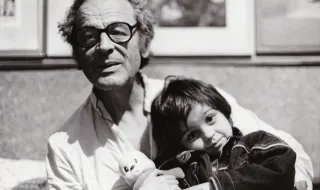
On March 16, 1978, State Security officers entered Todor Tsonev's home. Nearly 500 cartoons were seized, and the artist spent 68 days in the service's custody. The drawings, created over the years, remained inaccessible until the beginning of 1990. Then they became one of the strongest artistic testimonies of the lack of freedom during late socialism.
On January 11, 1990, the exhibition “Chronicle of Authoritarianism“ was opened in Sofia. 499 of the confiscated caricatures and 29 small sculptures are shown. The interest is enormous, and the queues in front of the gallery at “Shipka“ 6 become part of the history of the exhibition.
The student of Iliya Beshkov
Todor Tsonev was born on July 22, 1934 in Sofia. His mother is the folk singer Doyka Dobreva, and his father Dobri Tsonev is from the Dobrudja village of Sveshtarovo. His desire to draw was evident at the age of three. At the age of 16 he was accepted into the Academy of Arts as a particularly gifted person.
He graduated in 1957 in the class of Prof. Iliya Beshkov. In the words attributed to Beshkov, the young artist did not want to illustrate individual authors, but “the great book of life“. His thesis is composed of caricatures, among which there is an image of Beshkov himself.
Tsonev does not limit himself to one genre. He works in graphics, painting, satirical sculpture, woodcarving, metal sculpture, etching and murals. His first solo exhibition in 1970 presented 142 small sculptures, and in 1977 he showed about 350 works in an exhibition of satirical sculpture.
Satire as a civic position
The most famous remain his political caricatures directed against Todor Zhivkov and the communist establishment. After the confiscation, Tsonev did not give up his public presence. Between 1991 and 1999 he published the newspaper “Satire“ together with art critic Maria Ovcharova.
“I will never stop following the fate of my people with the greatest vigilance“, says Todor Tsonev.Not only caricatures remain after him. The Art Gallery in Balchik preserves 413 of his drawings, lithographs, graphics, cartoons and caricatures, as well as 108 issues of “Satire“. The Museum of Humor and Satire in Gabrovo preserves 147 of his original caricatures. Among them is the collection “Bai Ganyo“, donated by the artist a month before his death.
Tsonev is also the author of the first statuette “Golden Aesop“, awarded at the International Biennale in 1973 and 1975. He died on October 23, 2004 after a serious illness, but his drawings continue to remind us that satire is not just a joke. Sometimes it is a way to preserve the memory of a time when fear seemed stronger than man.
Sources: bgnes.bg, old-news.bnr.bg, utroruse.com