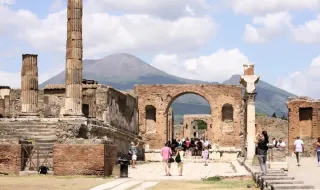
Four floors, corridors and staircases, arranged like a labyrinth, turn the house of Marcus Fabius Rufus into one of the most impressive residences in Pompeii. The ancient home will be completely restored with a private donation of over 1.4 million euros, and part of it is expected to be open to organized groups with a guided tour around the Christmas holidays.
The house was built directly on the city walls and was designed in the style of Roman imperial palaces. The building was buried by the ash of Mount Vesuvius during the eruption of the volcano in 79 AD, when Pompeii was destroyed.
The house has not received visitors since 1980. Structural strengthening works were carried out in 2021-2023, and the current stage of the project is mainly focused on the restoration of the frescoes.
Pompeii's largest unearthed home granted $1.6M restoration being funded by private donor https://t.co/XGbOpN0xok https://t.co/Xvdzaf3rRI
— New York Post (@nypost) October 21, 2026Among the most valuable images is a fresco of Venus, located in a domestic chapel. It is believed that the owner of the residence was a high magistrate or a freed slave of the imperial court with significant financial resources.
Financing was provided by German entrepreneur Frank Höfer. He contacted the management of the Archaeological Park “Pompeii“ after reading a book by director Gabriel Zuchtrigel, published in 2023.
“The restoration of the grandiose residence of Marcus Fabius Rufus is a project that I find extremely exciting,“ said Höfer.
One of Pompeii's largest houses is undergoing restoration, funded by private sponsors for €1.5 million to preserve the home's historic structure. The home will remain part of the Archaeological Park of Pompeii, open to the public for guided tours. https://t.co/Iki6a9OR3L https://t.co/Vyc33ORjLD
— ABC News (@ABC) October 21, 2026He said Pompeii is open to new approaches to preserving its archaeological heritage and ensuring public access to it.
The park team is also working on digital solutions to make it easier to navigate the complex's complex architecture. The corridors, staircases and different levels make visiting difficult without a guide.
“In places you have the feeling that you are in a 19th-century Neapolitan palace, but in fact it is a Roman house from 2,000 years ago,“ said Zuchtrigel.
The director indicated that private sponsorship could become a broader model for the development of the site. He specified that this would not automatically lead to the abolition of the entrance fee, but is a long-term direction for expanding the possibilities for restoration and access to the archaeological park.