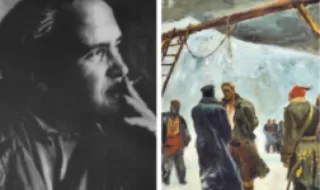
A letter for Boris Angelushev is never just a letter. It can be a line, a sign, a movement and part of the overall rhythm of the page. It is with this understanding that the artist, born on October 25, 1902 in Plovdiv, changes Bulgarian book design and leaves his mark as a graphic artist, illustrator, caricaturist and poster artist.
Angelushev studied applied graphics at the Academy of Arts in Berlin. In Germany, he began publishing political drawings and caricatures under the pseudonym Bruno Fuk. He worked for left-wing and opposition publications, and his works were directed against militarism, racism and the rise of fascism.
In 1926, he illustrated the German translation of the poem “September“ by Geo Milev. His cartoons against Nazi policies forced him to leave Germany in 1933. After a stay in Czechoslovakia and Switzerland in 1935, he returned to Bulgaria.
Books that generations remember
In Bulgaria, Angelushev worked on books, newspapers and magazines, gradually becoming one of the most influential figures in the development of modern graphics. He illustrated “Uncle Tom's Cabin“ by Harriet Beecher Stowe, “Fairy Tales“ by Andersen, “Bai Ganyo“ by Aleko Konstantinov and “Nemily-nedragi“ by Ivan Vazov.
In 1940, he designed the cover of the first edition of “Motor Songs“ by Nikola Vaptsarov. Among his other works are covers and illustrations for books by Elin Pelin, Georgi Karaslavov, Thomas Mann, William Shakespeare and Alexandre Dumas. His style is also recognizable in the layout of publications such as “Literary Front“, “People's Youth“ and “Hornet“.
“He gave the Cyrillic alphabet this graphic modernity, which provided it with diversity and vitality“, says artist Atanas Neykov-Nayo about Angelushev's contribution to the font and the book.
From historical canvases to the BTA logo
Angelushev did not limit himself to illustration. Among his memorable pictorial compositions are “Asparuh's Cavalry Crosses the Danube“ from 1939 and “The Hanging of Vasil Levski“ since 1942. He also created postage stamps, posters, drawings for the press and works with historical themes.
In 1964, the artist created the logo of the Bulgarian Telegraph Agency. In it, the globe is made up of the letters of the abbreviation BTA. The sign became a permanent visual emblem of the agency and continues to be present in its publications.
After September 9, 1944, Angelushev painted the first propaganda posters of the new government and went to the front as a war artist. This period is part of the complex social and political context in which his work developed.
Boris Angelushev died on August 24, 1966 in Sofia. Two years later, the Union of Bulgarian Artists established an award in his name for achievements in illustration and book design. Thus, his name remains associated not only with specific drawings, but also with the way the Bulgarian book looks, speaks and is remembered.
Sources: archives.bnr.bg, bta.bg, news.bg