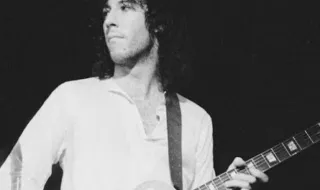
Before Fleetwood Mac became the band of the “Rumours“ era, its name was inseparable from one person – Peter Green. He is the guitarist, singer and songwriter who created the early sound of the band, and his career shows how quickly fame can be overwhelming for the man behind it.
Peter Alan Green was born on October 29, 1946 in the London neighborhood of Bethnal Green. He began playing guitar at the age of 10, and his first musical influences were the skiffle, rock and roll and blues of Muddy Waters and B.B. King. In 1966, he took over from Eric Clapton as lead guitarist for John Mayall & the Bluesbreakers. It was there that he met drummer Mick Fleetwood and bassist John McVie.
Three years that changed Fleetwood Mac
In 1967, Green founded Fleetwood Mac with Fleetwood. They were joined by guitarist Jeremy Spencer and later John McVie, whose surnames gave the band its name. The debut album Fleetwood Mac was released in February 1968, reaching number four in the UK charts and staying there for 37 weeks.
In less than three years, Green wrote a series of songs that became the basis of the band's early repertoire. Among them were Black Magic Woman, Albatross, Man of the World, Oh Well and The Green Manalishi. Albatross topped the British charts, and Man of the World reached number two. Black Magic Woman was later given new life by Santana's version.
His music is both restrained and tense. On Albatross the guitar sounds almost like distant surf, while on The Green Manalishi a dark and haunting motif emerges. B.B. King described Green as “the only guitarist who ever gave me goosebumps” - an assessment that summed up his influence on a generation of British blues musicians.
Departure and long retirement
Green left Fleetwood Mac in May 1970, when the band was already establishing itself as an international force. According to The Guardian, he was plagued by anxiety, mental health issues and guilt over the band's growing income. The song The Green Manalishi is related to his financial worries.
After his retirement, Green spent years in isolation and treatment. Sky News reported that he was later diagnosed with schizophrenia and that he was treated in psychiatric hospitals. This period coincided with the rise of a different line-up of Fleetwood Mac, which would later achieve huge success with a more pop sound.
Return to music
In the late 1970s and into the 1980s, Green gradually returned to recording. In 1997, he founded the Peter Green Splinter Group, with which he released eight albums by 2003. In 2009, he created the project Peter Green and Friends and reappeared on stage.
In 1998, he was inducted into the Rock and Roll Hall of Fame along with Fleetwood Mac. He died on July 25, 2020 at the age of 73, but left behind a catalog that connects the London blues of the 60s with the later history of rock music. The most important thing in it is not the quantity, but the density of those three years in which Peter Green turned a new band into a name that the world will not forget.
Sources: theguardian.com, news.sky.com, scotsman.com