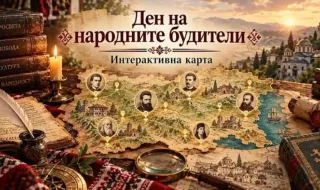
On November 1, Bulgaria celebrates the Day of the Awakeners of the People. Traditionally, we talk about Paisii Hilendarski, Sophrony Vrachanski, Vasil Levski, Hristo Botev, Lyuben Karavelov, Georgi Rakovski, and Ivan Vazov. Their names are inscribed on monuments, schools, and streets, and their lives and deeds are part of the national narrative.
But there is a lesser-known side to this story - not everyone has accepted the glorification of these individuals without reservation. Sometimes the veneration of them has provoked envy, literary wars, political conflicts and even open protests. In other cases, the monuments themselves, the celebrations and attempts to impose a certain national pantheon have turned into real public scandals.
It turns out that the dispute over who deserves a place among national heroes is not an invention of modern social networks.
Ivan Vazov - why does the nationwide celebration of the Patriarch of Bulgarian literature anger his colleagues?
Today, Ivan Vazov is an almost untouchable figure in Bulgarian literature. We call him the Patriarch of Bulgarian literature, and his works are an integral part of our education and national memory.
But even during his lifetime, the recognition he received caused serious controversy.
In 1895, the first major national celebration of a Bulgarian writer was organized - the occasion was the 25th anniversary of the beginning of Vazov's literary activity. The event was on a scale that the Bulgarian cultural community had never known before. The writer received a congratulatory address from Prince Ferdinand and was awarded the Order of “St. Alexander“.
However, it was precisely this unprecedented enthusiasm that irritated some of the literary circles.
Pencho Slaveykov was particularly sharp, who did not accept the national veneration of Vazov uncritically. In the circle around the magazine “Misl“ a critical line is formed that questions the artistic value of his work. Dr. Krastyo Krastev, who has been criticizing Vazov for years, joins in the negative assessments.
But the literary conflicts surrounding the writer began even earlier. Zahari Stoyanov also entered into a sharp polemic with him. In 1883, he attacked his work with extremely scathing assessments. Vazov did not remain oblivious and responded with criticism, including through the poem "To a Mud"
Thus, the man who is today a symbol of national literature was once accused of mediocrity by other great names in Bulgarian culture.
The interesting thing is that the dispute is not simply about personal dislike. It is a clash between different ideas about what Bulgarian literature should be – whether to follow national ideals and be close to the general public, or to seek new artistic forms and higher aesthetic criteria.
Today Vazov is among the most revered Bulgarians, but in 1895 his recognition was far from unanimous.
Hristo Botev – three monuments, three scandals and a battle for national memory
Few personalities are as strongly connected to our national identity as Hristo Botev. In Vratsa, his name is everywhere – a square, a monument, annual celebrations and a solemn torchlight procession.
However, the history of the monument itself is filled with tension.
The first monument to Botev was unveiled on May 27, 1890 in Vratsa. The ceremony was attended by Prince Ferdinand, Stefan Stambolov, the revolutionary's mother and wife. However, even then, controversy arose.
Vratsa Metropolitan Constantine, known for his Russophile beliefs and his opposition to the ruling class, refused to attend the opening. A demonstrative presence of Russophile former volunteers also formed around the ceremony, who did not return the prince's greeting.
There was another problem - the very image of Botev was not to the liking of some of those present. His mother and wife were disappointed with the presented figure, as it did not correspond to their idea of the tall and large revolutionary.
But the biggest scandal was yet to come.
In 1955, during the reign of Valko Chervenkov, the first monument was dismantled. According to published historical accounts, the communist leader disliked the work by Austrian sculptor Gustav Eberlein and described it as bourgeois. The monument was removed overnight, without prior public discussion.
The reaction of the people of Vratsa was sharp. Written protests were received by the local authorities, and many residents perceived the dismantling as an encroachment on Botev's memory.
A temporary monument was built next, and in 1964 the current 12-meter monument was unveiled.
And the story does not end there. The project by sculptor Vladimir Ginovski initially met with serious objections from local councilors. They did not like that Botev was depicted with a lowered sword and a scroll with poems next to his heart. The sculptor even vowed not to return to Vratsa, but later agreed to implement the project.
Thus, the history of one of the most revered Bulgarian revolutionaries turns out to be connected with political confrontations, dissatisfaction and disputes about what the national hero should look like.
The People's Awakeners – why was even the creation of the national pantheon a political issue?
The Day of the People's Enlighteners itself has an interesting history that shows how difficult it is to build a common national memory.
The holiday was officially declared in 1922 at the suggestion of the Minister of Public Education Stoyan Omarchevski. The idea arose in a society that had experienced national catastrophes, wars and severe political disappointments.
The goal is to pay common tribute to the Bulgarian enlighteners, writers and revolutionaries.
But before the appearance of this holiday, the question of which personalities deserve the greatest recognition had already caused conflicts.
The scandal of 1901, when the 25th anniversary of the April Uprising was celebrated, was particularly telling. Then a student demonstration opposed the mixing of the commemoration of the insurgents with the laying of the first stone for the monument to the Russian Emperor Alexander II in Sofia.
The young people insisted that the emphasis be on the Bulgarian heroes and their sacrifice, and not on the monument to a foreign ruler. The clash is indicative of the then social division between the different political and historical interpretations of the Liberation.
It is precisely such conflicts that show that national memory has never been a completely neutral territory.
„I am a Bulgarian“ - can Vazov's poem become the cause of a contemporary public scandal?
If someone thinks that the disputes over national symbols are a thing of the past, it is enough to recall the storm surrounding the poem „I am a Bulgarian“ in January 2024.
The reason was a published opinion on the education system and the integration of children of different ethnic backgrounds. It raised the question of whether schools should also take into account the cultural experience of children from minorities.
The text caused violent reactions, and allegations began to spread in the public space that Vazov's poem would be removed from textbooks.
The Ministry of Education and the then Prime Minister Nikolay Denkov must refute such allegations.
The case shows how easily a literary text can become a political symbol and a cause for public opposition. The poem itself was not the subject of an official ban, but Vazov's name once again finds itself at the center of a heated debate.
Here, the question is no longer whether the writer deserves recognition, but who has the right to determine how his work should be read and taught.
Who actually decides who is a revivalist and who deserves a monument?
The stories of Vazov, Botev, and the creation of the Day of the National Awakeners show something important - national heroes are not just figures from the past. They are also the field of public battles.
Sometimes the dispute is literary, sometimes it is political, and sometimes it is related to the way a generation wants to remember history.
There are cases in which the veneration was excessive according to a given person's contemporaries. There are also cases in which monuments have been removed not for lack of merit, but for political reasons.
That is why perhaps the most interesting question about November 1 is not only who our luminaries are, but how we decided to turn them into national symbols.
Because behind every monument stands not only the person to whom it is dedicated, but also the era that erected it, the politics that supported it, and the society that sometimes opposed it.
And history shows that even the highest pedestal does not guarantee universal consent.