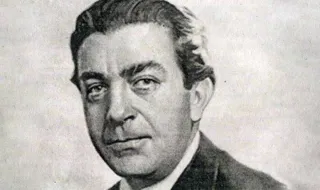
In the final days of his life, Veselin Hanchev wrote poems that conveyed both pain and a defiant sense of life. One of the most memorable titles associated with his name is precisely “I Am Alive.” On November 4, 1966, the poet died in Sofia at the age of just 47. Six decades later, he continues to be present in Bulgarian literature not only through his books, but also through the young authors who carry his name in their competitions and first poetry collections.
The Poet Between the Front, the Theater and Diplomatic Missions
Veselin Hanchev was born on April 4, 1919, in Stara Zagora. He graduated in law from Sofia University, but his professional path soon turned toward literature. He worked for the newspaper “Literaturen Glas,” and after 1944 he held various positions at Radio Sofia, the National Opera, the Satirical Theater, the magazine “Plamak” and Bulgarian Cinematography.
Between 1962 and 1966, he was cultural affairs adviser at the Bulgarian embassies in Warsaw and Paris. This biography brings together poetry, theater, journalism, translation and state cultural work in one place. Hanchev translated French and Russian poets, while his poems reached readers in several European and Asian languages.
From “Spain at the Crossroads” to “To Remain”
His first poetry collection was “Spain at the Crossroads,” published in 1937. It was followed by books such as “Poems in the Cartridges,” “Lyrika,” “The Wind Rose” and “To Remain.” They bring together civic anxiety, wartime experience, love, loneliness and the striving for human dignity.
Hanchev also wrote for children and young people, created the plays “Gold,” “Poisoned Dove” and “The Two and Death,” as well as the unrealized screenplay “Krali Marko.” He was twice a laureate of the Dimitrov Prize, a recipient of the Order of Cyril and Methodius, First Class, and the title “Distinguished Cultural Figure.”
“Unobtrusively and Naturally, He Became a Great Poet”
After his death, hundreds of people gathered at the Ivan Vazov National Theater to bid farewell to the poet. In its archival material, the Bulgarian News Agency quoted the words of Bozhidar Bozhilov from the memorial rally: “Unobtrusively and naturally, he became a great poet.” In the same text, Hanchev is described as an author of poetry in which “iron and tenderness” meet – a description that brings together two of the strongest poles in his work.
His memory does not remain only in libraries. In 1984, the “Veselin Hanchev” National Youth Poetry Competition was established in his native Stara Zagora. Its first prize includes the publication of an independent debut poetry collection, and the competition is also being held in 2026 for the 43rd time. Thus, the poet’s name continues to be associated not with the past, but with the emergence of new voices.
Veselin Hanchev died young, but he left behind books in which personal feeling and social destiny are inseparable. Sixty years after his death, his “I Am Alive” sounds not like a summation, but like a literary continuation.
Sources: bta.bg