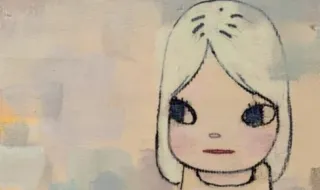
At first glance, they are simply girls with enormous heads and wide-open eyes. They appear on T-shirts, skateboards, bottles and stickers, but their gaze is rarely innocent. These small figures can look angry, bored, defiant or confused – and that is precisely what has made Yoshitomo Nara one of the most recognizable Japanese artists of the 21st century.
Now his heroines occupy a new space in New York. David Zwirner gallery has opened Nara’s first major solo exhibition in the city in nearly a decade. The exhibition brings together new and previously unseen works, older pieces, small drawings on torn scraps of paper and large portraits whose bright eyes create the sensation that they are watching the visitor.
The opening attracted a young and stylish crowd. The artist’s admirers waited nearly an hour in a line stretching for two blocks. Some carried bags with Labubu figures, while others wore tabi shoes. Visitors also flocked to nearby Niagara, the bar where Nara painted in 2009. His graffiti there has been preserved behind a plastic covering.
Sweetness as camouflage
“Sweetness is more of a camouflage for something that is more protected,” says curator Mika Yoshitake. In her view, the large eyes and round faces can easily be perceived as innocent, but the heroines’ gazes are often sidelong, expressionless or openly aggressive.
Nara himself has described his figures as a kind of self-portraits – bearers of his emotions. He grew up in a rural area of northern Japan during the 1960s and 1970s, in the decades following the Second World War. The country’s wartime history, loneliness and sense of loss remain hidden layers in his work.
After studying at Kunstakademie Düsseldorf in the late 1980s, Nara developed the political dimension of his art even further. In the 2019 painting “We Stop the Bombs,” the message is direct – resistance to war and to what the artist sees as injustice in society.
Girls with knives and a global audience
The solitary children in Nara’s paintings sometimes hold knives or axes. For Kevin Lenarts, creative director of The Skateroom, these images speak of weariness with injustice and a readiness to fight back against it. The collaboration between The Skateroom and Nara, which produced limited-edition skateboard series, became one of the company’s most successful.
Rock music has also influenced the artist; it was an important part of his childhood in rural Japan. This connection with counterculture helps his heroines appear simultaneously lonely, rebellious and close to generations that grew up in a world of constant crises.
The art market also demonstrates the scale of interest in Nara. The painting “Knife Behind Back,” featuring a frowning girl hiding one hand behind her back, sold for $24.94 million in 2019. This remains the artist’s record. The New York exhibition runs until December 12, 2026, while his parallel museum exhibition in Washington presents monumental sculptures created after the 2011 nuclear disaster in Fukushima.
Sources: cnn.com, news.artnet.com, nyandnj.com