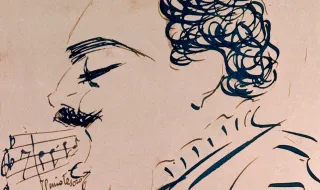
Before the large sound-collecting horn of the early gramophone, Enrico Caruso sings “Vesti la giubba” – the aria of the clown Canio from Ruggero Leoncavallo’s opera “Pagliacci”. Thus, in 1902, the voice of the Italian tenor ushered in the era of million-selling sound recordings.
Guinness World Records identifies the recording as the first in history to sell more than 1 million copies. According to the reference source, it was recorded in November 1902 and released by the Gramophone & Typewriter Company.
The aria that moved beyond the opera house
“Vesti la giubba” is heard at the end of the first act of “Pagliacci”. In it, Canio must return to the stage and play the role of a cheerful clown, even though his personal tragedy has just been revealed. Caruso turned this scene into one of the most recognizable performances in the history of opera.
The technology of the time was far removed from today’s studio recordings. There were no electric microphones or amplifiers. The singer had to direct his voice into a metal horn, which transmitted the sound vibrations to a diaphragm and a needle. It was this mechanical system that recorded the performance onto the record.
The first version of the aria was made in Italy in 1902, and Caruso recorded it again in 1904 and 1907. This is precisely why it is clarified that the expression “the first million-selling recording” refers to the song and its successive releases, rather than necessarily to a single record.
Historical fame comes with a qualification
The U.S. Library of Congress states that Caruso’s recording for Gramophone sold more than 1 million copies worldwide, while the later releases for Victor and RCA brought millions more in sales. In the same context, Mark Caruso describes the performance as a recording that “would determine the direction in which sound recording would develop and the way records would be bought”.
Some sources, however, associate the specific crossing of the 1 million mark with the 1904 version. A study by the University of Cambridge notes that there is no reliably established date on which the millionth copy was sold. Data from American company records show only several thousand copies sold of individual Caruso recordings in 1904, making the early statistics difficult to verify.
This does not change Caruso’s place in music history. The tenor, born in Naples and making his debut at the Metropolitan Opera in 1903, was the first great opera star to reach a global audience through the gramophone. His voice no longer depended solely on the concert hall and live performance – it could be owned, reproduced and listened to by millions of people.
Sources: content.time.com, cadenaser.com, lagazzettaitaliana.com