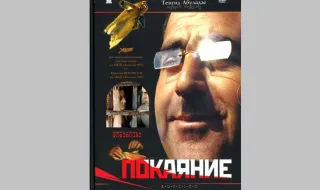
At the end of the film, the silence in the auditorium proves almost as powerful as the story itself. On November 13, 1986, Tengiz Abuladze’s “Repentance” was screened at the Central House of Cinematographers in Moscow – a film completed as early as 1984 but held back by Soviet censorship until then.
The premiere became a cultural event because the film speaks through a parable about dictatorship, political repression and the fear that continues to live on even after the dictator’s death. “Repentance” is often described as the first major film from the so-called “shelf”, released to the public after Mikhail Gorbachev’s policy of glasnost began. More precisely, it was one of the first and most powerful works released from censorship during this period.
The film that waited three years
Abuladze made “Repentance” as an allegory in order to avoid a direct confrontation with official ideology. At its center is Varlam Aravidze – a fictional ruler whose funeral does not put an end to his crimes. His body is repeatedly dug up by a woman who refuses to allow society to forget what he did.
Behind the image of Aravidze, viewers recognized the Stalinist era and its successors, although their names are never spoken. The film was produced by Georgian television and remained unavailable on the big screen until the end of 1986. The limited screenings in Moscow were followed by nationwide distribution in 1987.
“As an artist, I have no need for perestroika. My artistic and civic principles have remained the same as they were 20 years ago,” Tengiz Abuladze said in an interview with the Christian Science Monitor.The film’s story is also the story of a changing Soviet cultural climate. Just a few years earlier, such an account of terror, guilt and responsibility would have been impossible to show publicly. “Repentance” appeared at a moment when glasnost was beginning to open up topics long considered untouchable.
Three awards in Cannes, not four
In 1987, the film competed in the official selection of the 40th Cannes Film Festival. According to the festival’s official archive, “Repentance” won the Grand Prix and the FIPRESCI Prize. It was also honored by the Ecumenical Jury. The film was nominated for the Palme d’Or but did not win it – the award went to Maurice Pialat’s “Under the Sun of Satan”. Thus, the verifiable number of awards it received in Cannes is three, not four.
The success in Cannes made Abuladze an internationally recognized director and the film one of the symbols of Soviet perestroika. Its power lies not only in its direct condemnation of tyranny but also in the question of what ordinary people do with the memory of it.
Six Nika Awards
In 1988, “Repentance” dominated the first Nika Awards ceremony, held in Moscow. The film won in all six categories in which it was nominated: Best Film, Best Director, Best Screenplay, Best Cinematography, Best Actor and Best Production Design. The winners included Tengiz Abuladze, screenwriters Nana Janelidze and Revaz Kveselava, cinematographer Mikhail Agranovich, production designer Georgi Mikeladze and actor Avtandil Makharadze.
That same year, Abuladze received the Lenin Prize for his entire trilogy – “The Plea”, “The Wishing Tree” and “Repentance”. The final film remains its most painful and politically charged conclusion: a reminder that the past does not disappear simply because people were forbidden to talk about it.
Sources: washingtonpost.com, csmonitor.com, content.izvestia.ru