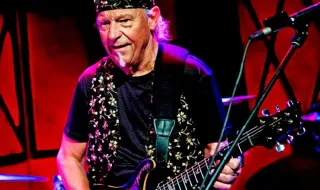
When Martin Barre turns 80, the number represents one of the longest guitar careers in progressive rock. He was born on 17 November 1946 in King's Heath, Birmingham, and before the guitar came into his hands, there was a saxophone. In the early 1960s, he played with The Moonrakers, The Noblemen and The Motivation, later becoming part of The Penny Peeps. The band released two singles for Liberty Records.
His path to Jethro Tull came in 1968. He took the place of Mick Abrahams and proved to be the musician who would remain alongside frontman Ian Anderson the longest. The band's first album with Barre was Stand Up, released in 1969. The record reached number one in the UK and marked an important change in the band's direction as it gradually moved away from the blues.
The guitar sound behind „Aqualung“
Barre played on every Jethro Tull album from Stand Up through The Jethro Tull Christmas Album in 2003. His name is most strongly associated with 1971's Aqualung. His guitar solo in the title track became one of the album's defining features and was later included in rankings of the most influential rock solos.
In a 2025 interview with Guitar World, Barre rejects the idea of himself as a „guitar hero“. „I love playing guitar. I love guitars, amplifiers, sounds and music. But that concept doesn't speak to me,“ he says.
His approach differs from demonstrative virtuosity. The guitar parts in Jethro Tull often work as a counterpoint to Ian Anderson's flute and voice rather than standing above them. This interplay can be heard in songs such as „Locomotive Breath“, „Cross-Eyed Mary“ and „Aqualung“.
From the blues to progressive rock
Jethro Tull's transition to progressive rock did not happen all at once. In a conversation published in August 2026, Barre recalled that the band did not know how the new direction would be received. „Jethro Tull was a blues band and people asked: „What happened to you?“, but we gradually won them over,“ he says.
In 1989, Jethro Tull won a „Grammy“ for the album Crest of a Knave in the Best Hard Rock/Metal Performance category. The award came at a time when the band had already spent two decades constantly changing its style.
Barre and Anderson's time together came to an end around 2011, when Jethro Tull's original line-up broke up. After that, the guitarist began building his own live career, performing both solo material and songs from the band's repertoire. „I've played on every one of those albums and written many of the guitar parts,“ he told WGLT in 2024.
The guitar as a refuge
In his autobiography, A Trick of Memory: The Autobiography of Jethro Tull’s Guitarist, published in 2025, Barre also writes about his intense shyness as a child. „If I'm in a band, I won't have to dance. That's a great idea,“ he recalls of the reason he turned to music.
Today, he continues to play with his own band and present concert programmes such as A Brief History of Tull. For a musician who spent more than 40 years in one band, this is not simply a way of repeating the past, but of keeping alive the partnership between the guitar, the flute and the songs with which Jethro Tull remain part of rock history.
Sources: guitarworld.com, loudersound.com, wglt.org