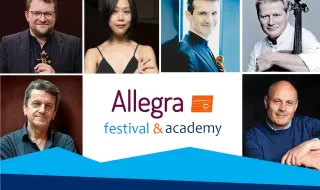
The Grand Chamber Music– three concert evenings inspired by the most intimate format in classical music. At the centre of the universe of magnificent instrumentalists who have accepted Allegra’s invitation is Svetlin Roussev, whom we will have the pleasure of hearing both as a chamber musician and as a soloist with the Allegra Festival Orchestra.
Because great chamber music is performed by great musicians!
Allegra—the festival for connoisseurs that has become a benchmark for taste and a preserve for unexpected interpretations of renowned musical works—is a thematic concept introduced by Allegra’s creator, Petar Naydenov, and places chamber music at the centre of its upcoming winter edition, 8–13 February 2027.
Following two successful editions dedicated to Romanticism in classical music (The Romantic Project) and Ludwig van Beethoven (The Beethoven Project), The Big Chamber Music, or great chamber music, is dedicated to the heart of classical music—the small ensembles that emerged and became established as concert formats in the 17th and 18th centuries. The name Chamber Music derives from the Italian word camera (room), as the works were initially intended for small salons or reception rooms in aristocratic palaces rather than for large concert venues.
Chamber music creates an unparalleled intimacy between performers and audience. It is an art of dialogue and shared emotion, in which every instrument has its own voice, while the musicians together build a living, breathing organism. This very act of music-making lies at the heart of Allegra’s winter edition.
Not only strings—new timbres and new musical horizons!
Allegra Festival is known for bringing its audience together with outstanding string instrumentalists. In its upcoming winter edition, however, Allegra expands the intimacy of its chamber concerts by adding the timbres of three wind instruments. Clarinet, bassoon and horn will introduce new contrasts and nuances to the ensemble sound. This festival edition also highlights three distinctive artistic personalities, three impressive musical worlds—one of Bulgaria’s most prominent clarinettists, Borislav Yotsov, Swiss bassoonist Gábor Mészáros and horn player Jörg Brückner, whose remarkable career has taken him from the Gewandhaus Orchestra to the Munich and Berlin Philharmonics.
Over two evenings—on 8 and 10 February—the stage of Sofia’s Military Club will become a salon for the most refined form of musical art.
The first evening, on 8 February, presents a masterful parallel between two works by Ludwig van Beethoven—the arrangement of his Second Symphony for piano trio (Op. 36) and the iconic Septet in E-flat major (Op. 20).
The opening concert is a true gift for music lovers, also because of the world-class virtuosos gathered on the stage of Allegra Festival. Immediately after the sold-out BBC Proms 2026 concert at London’s Royal Albert Hall, one of the most celebrated pianists of our time—the South Korean pianist Yeol Eum Son—arrives in Sofia. Known for her poetic elegance, crystalline tone and phenomenal technique, she brings Viennese Classicism into a new dimension. Alongside her is audience favourite Svetlin Roussev—a violinist of fiery temperament, charisma and international acclaim.
His encounter with Yeol Eum Son and Peter Somodari, principal solo cellist of the Vienna Philharmonic—three artists distinguished by stylistic precision and an authentic Viennese sound—will breathe new life into Beethoven’s Trio in the aristocratic ballroom of the Military Club. In the second part of the evening, they will be joined by five more exceptional musicians: violist Lech Antonio Uszynski (violist of the Stradivari Quartet), festival founder and double bassist Petar Naydenov, as well as leading masters of wind instruments—Borislav Yotsov (clarinet), Gábor Mészáros (bassoon) and Jörg Brückner (horn).
The festival’s second evening, on 10 February, takes the audience into the poetic world of Franz Schubert, where the sincerity of human feeling becomes pure sonic beauty. Two very different works—the dramatic Quartettsatz (D 703) and the light-filled Octet in F major (D 803)—outline the full spectrum of the young composer’s emotions. The musical journey begins with Quartettsatz, one of Schubert’s most emotionally intense and concentrated works, in which turbulent anxiety and inner yearning give way to breath-taking lyrical tenderness. The only completed movement of the planned string quartet remained hidden from the world for a long time and saw the light of day thanks to Johannes Brahms, who recognised it as a true masterpiece. The Octet in F major reveals an entirely different world.
Schubert’s largest chamber work was inspired by Beethoven’s Septet and brings together string and wind instruments—two violins, viola, cello, double bass, clarinet, horn and bassoon. In its six movements, filled with songs, dance rhythms and enchanting dialogues between the instruments, the listener enters the welcoming world of Viennese salons, where music is a shared joy.
The two works demonstrate the full maturity of Schubert’s genius. They gain depth from the exceptional violinists Svetlin Roussev and Valeriy Sokolov, together with Lech Antonio Uszynski (viola) and Peter Somodari (cello). In the Octet, they will be joined by Petar Naydenov (double bass) and the masters of wind instruments Borislav Yotsov (clarinet), Gábor Mészáros (bassoon) and Jörg Brückner (horn).
At the festival’s final evening, on 13 February, chamber intimacy will unfold into symphonic power at Bulgaria Hall, bringing together in a single concert experience the monumental world of Johannes Brahms and the triumphant energy of Ludwig van Beethoven—a story about art as the highest moral duty, friendship and purification.
The first part of the evening is an introduction to Beethoven’s dramatic world. Symphony No. 2 in D major was written at a time when the composer was horrifically coming to terms with the irreversibility of his deafness and left a deeply confessional letter on the brink of despair. And yet it is an astonishing triumph of the spirit: instead of darkness, bubbling energy, humour and steadfast optimism. Exhilarating momentum in the first movement, a warm lyrical idyll in the second, rebellious and infectious energy in the third, and a sparkling, joyful finale.
The programme continues with Brahms’s Double Concerto for Violin, Cello and Orchestra in A minor—a work born of the need to heal a fractured friendship through the power of music. The two solo instruments are a true allegory of human communication: the violin and cello converse, argue, yield to one another and complement each other, breathing as one organism in order to arrive at a shared maturity filled with intimacy and meaning.
The soloists are Svetlin Roussev and László Fenyő—two artists from the world’s musical elite and great friends of Allegra Festival. A favourite of Bulgarian and international audiences, Svetlin Roussev commands respect with his stage presence, noble and richly textured tone, and dazzling virtuosity. At present, he continues to develop an impressive international career as a soloist and chamber musician, winning the applause of audiences in Europe and Asia’s most prestigious halls and festivals. He plays the priceless 1716 Stradivarius “Baron Wittgenstein”, provided to him by the Bulgarian state, and offers listeners refined stylistic culture and captivating artistic drive.
Hungarian cellist László Fenyő, winner of first prize at the Pablo Casals Competition, is among the most sought-after soloists of our time. Known for his profound musical sensitivity, rich tonal palette and flawless technique, he plays a 1695 Matteo Goffriller instrument whose noble sound fills the hall with incomparable warmth.
Brahms’s Double Concerto is a serious test: it requires the soloists to set their personal egos aside and make music as one. The elevated radiance of the Stradivarius and the velvet register of the Goffriller can be combined only through perfect intonational synchronisation and genuine stage chemistry. For the audience, it will be a privilege to follow this intense dialogue—from the dramatic cadenzas at the beginning, through the moving unison of the slow movement, to the sparkling Hungarian finale.
Taking the conductor’s podium is Allegra Festival’s great friend, maestro Johannes Schlaefli, who will remain true to his vivid temperament, refined stylistic culture and sensitivity to the finest emotional nuances—qualities well known to Allegra’s audience. As is traditional at the festival’s final evening, the musicians of the Festival Orchestra will also take the stage.
More information about the programme and soloists, as well as tickets, can be found HERE
The opportunity to purchase individual tickets with a 25% discount is also available until 20 November.
After 20 November, you will be able to purchase a festival ticket for all three concerts with a total discount of 30% for the respective price category.
Allegra Festival and Academy are held under the patronage of the Embassy of the Swiss Confederation.