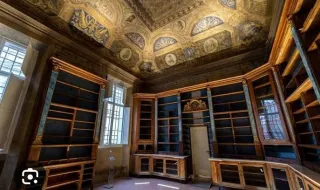
Under the streets of modern Rome, a place where books, documents and legal texts were stored nearly two millennia ago can once again be seen. The western library of Trajan’s Forum, traditionally associated with the „Ulpia“ Library, was opened to visitors on November 16 after 18 months of restoration work.
The hall is located below the current street level and was used as a storage area for a long time. It has now been converted into a permanent museum space as part of Rome’s „Museums in the Municipality“ system. The project was carried out with an investment of €1,755,000 under the „Caput Mundi“ programme, funded by Italy’s National Recovery and Resilience Plan.
Around 10,000 Volumes Near Trajan’s Column
Trajan’s Forum was inaugurated in AD 112 under Emperor Trajan. The two libraries were located on either side of Trajan’s Column, and their collection was probably divided into Greek and Latin texts.
The western hall is traditionally identified as the space for Greek works, while the eastern one probably housed Latin texts. According to the archaeological reconstruction, the walls had 36 niches containing cabinets for scrolls and books. The hall’s capacity is estimated at around 10,000 volumes.
„This is another part of the enormous work under the „Caput Mundi“ programme. An important fragment of our city is becoming accessible for the first time,“ Rome Mayor Roberto Gualtieri said at the opening.
At the same time, the city’s archaeologists note that identifying the hall as a library is a traditional interpretation, while the functions of these spaces are also being discussed in contemporary research. Ancient sources associate the „Ulpia“ Library not only with literary works, but also with the storage of official documents, edicts and legal materials.
A Walkway Above the Archaeological Remains
Visitors walk along a raised, reversible walkway that allows them to see the preserved structures without disturbing the archaeological remains. The hall displays a large capital from the pillars of the entrance portico, marble elements from the niches and other fragments from Trajan’s Forum.
One of the highlights is part of the ancient flooring, made from different types of marble, including white marble from Luna, green stone, granite and yellow Phrygian marble. Video mapping traces the changes in the area from the Roman era through the Middle Ages and the Renaissance to modern urban development.
The library is open to visitors from Friday to Sunday. Groups are limited to 20 people, and admissions are every 40 minutes between 9:20 and 15:20. The regular ticket costs €7, while the reduced ticket costs — €5. Admission to the library does not include the separate ticket for the archaeological area of the Imperial Fora.
Sources: roma.repubblica.it, agi.it, ansa.it