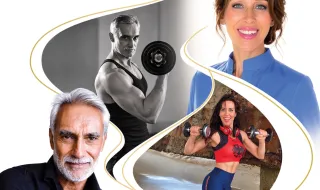
There is no biohack for training – there is consistency in the long game. Why health is not a sprint but a long-term strategy, and how everyone can build their physical and mental reserve, explains prof. Yulian Karabiberov.
- Prof. Karabiberov, you have devoted your life to the conditioning of elite athletes, working with Olympic champions and national competitors. What prompted you to move beyond the framework of traditional sports training and create a system that places not merely sporting achievement, but health, longevity and overall human potential at its centre?
- High-level sporting excellence has always been a priority for me. That is where the excitement lies: seeing a result considered a limit, and abilities considered the ceiling, turn out to be merely an intermediate stop on the path of growth. This growth, however, comes at a price, and that price is often health. Elite sport does not produce health. In this respect, we coaches are indebted to our athletes. But those who enjoy attractive competitions and records are also little interested in the health aspect of sport. The athlete, meanwhile, knows that there are no victories without training at the edge. As is clear, health is not the goal, but the sporting result.
Subsequently, it turns out that it is too late to show respect for health. So let us not wait for that moment. On the other hand, athletes must be physically and mentally healthy in order to withstand the extreme workloads and the stress they cause. The life of the ordinary person is increasingly beginning to resemble a competition. There is stress, toxins, mental tension, limitless ambitions and lack of sleep. This also distances us from health. The situation is similar: the organism of both the ordinary person and the athlete is operating under extreme conditions. The question is how to counteract the stressor. How do we create equilibrium and balance in the functioning of the organs and systems so that they can provide a combined/overall capacity that develops the ability to cope with the specifics that life and sport present every day? A harmonious unity is built between the person and the environment in which they live, and between the athlete and the environment in which they compete. That is why, personally, I do not separate but unite work in the field of elite sport and sport or physical activity for everyone, with each of the two groups taking into account the conditions of the tasks it must solve in order to achieve its goal. And that goal is specific adaptation to the working environment. So there is no moving beyond the framework. There are different ranges in which we seek solutions within individual zones. Proof of this is that my programmes for fitness and health preceded those for conditioning in sport – my book Fitness was published years before the one on Conditioning, not to mention that the first one, "Fitness – Physical Harmony and Health", dates from 1995. At the same time, the knowledge and scientific research in elite sport, for which considerable financial resources are allocated, make it possible to use valuable information in reverse for the needs of physical activity beneficial to every person.
The leading guidelines distinguish preparation for maximum performance from movement for health. In strength training for most adults, regularity and sustainability are more important than the complexity of the programme.
- „Neuroathletics“ is presented as an integral Bulgarian system that unites the nervous and muscular systems in a single scientific and practical architecture. What is the most significant innovation in this approach, and how does it differ from the fitness and training methods known so far?
- „Neuroathletics“ is a health and conditioning system that we created together with Dr Nedelya Shtonova. Her contribution is invaluable. As a specialist neurologist, she brought her clinical experience, while in her defended dissertation she studied the role of psychosocial risk factors in the development of central and peripheral atherosclerosis. This work places at the heart of the system a question that concerns us both: how do experiences, emotions, the way we think and prolonged stress affect the body and vascular health?
I contributed my experience in conditioning and in dosing physical activity. When a person trains, the muscle contracts, the nervous system controls and refines the movement, the heart and blood vessels ensure blood flow, and the cells meet the higher energy demands. With repetition and sufficient recovery, these systems adapt. That is why movement is one of the most powerful practical tools at our disposal for maintaining muscle function and brain and vascular health.
Vascular health has a central place in „Neuroathletics“. There is no healthy organ without healthy circulation. The brain, heart, kidneys and muscles depend on a continuous supply of oxygen and nutrients. Cancer is a diagnosis we understandably fear, but when we look at the causes of death in Bulgaria, we see that diseases of the circulatory system continue to rank first. In 2025, they accounted for around 61% of all deaths in the country. That is why caring for the blood vessels is the foundation of our system.
The most significant innovation is the way we have connected the modules. The nervous system, emotions and cognition, vascular health, sleep and recovery, metabolism and mitochondria have their own protocols, which intertwine in practice. For example, if a person sleeps poorly and recovers with difficulty, this matters for the workload we will prescribe. If they have good strength but feel insecure when walking down stairs, we will also work on balance, coordination and movement control. Thus, the choice of exercises begins with the question: what does the person want to be able to do, and what is currently limiting them?
In the movement component, this logic is implemented through the five modules of JN Fit Motion – preventive-stabilising, strength, athletic, functional-realisation and recovery. We work on stability, strength, endurance and coordination, and then transfer what has been acquired into specific actions. For one person, this means returning confidently to sport. For another, it means climbing stairs with shopping bags or lifting their grandchild.
This is what I mean by the integrity of the system. The brain organises movement, movement sends information back to the brain, circulation supports the work of the tissues, and recovery creates the conditions for adaptation. We connected these processes in one approach so that a person can turn acquired conditioning into greater freedom and independence in their own life.
-At the foundation of your training methodology are five modules – preventive-stabilising, strength, athletic, functional and recovery. How do they work together, and why do you believe that recovery should be an equal part of the training process rather than simply rest between workloads?
- The modular scheme is the backbone of our system. We work according to the principle of dissipative systems, in parallel and sequentially, but with priorities, where each most important component, called an attractor, changes from module to module. From the names of the five modules, you can guess what the priority is in each of them. Recovery is part of the process because that is where the actual development of motor qualities and abilities takes place. Building, or so-called anabolism, happens precisely after training, during rest, sleep, rational nutrition and so on. This means that we do not have passivity, but continuous activity in various forms. Regeneration and positive growth, however, are possible only if we have first organised an effective loading process that induces catabolism as a stimulus for subsequent anabolism. In this regard, we do not use stressors, but activators carefully dosed according to the degree of tension. Therefore, loading and recovery exist in a coordinated unity – the process is training-recovery.
Current scientific supplement: The effect of training also depends on the organism’s ability to recover. Sleep, nutrition and the distribution of workload are part of the process; the necessary recovery varies according to the person and the context. [5]
- You have worked with exceptional athletes such as Maria Grozdeva, Matey Kaziyski, Vladimir Zografski and Rado Yankov. What did elite sport teach you about the limits of human capabilities? Are there patterns in the preparation of champions that can also be successfully applied to ordinary people?
- Yes, there are patterns. Both champions training for high achievement and ordinary people engaging in sport for health and conditioning have talents and limits. The only difference is that each of them has their own mindset and readiness to reach them and unfold their potential. Not everyone possesses a champion’s potential, but everyone can unfold it to the limits available to them. That is precisely what Neuroathletics does – it unfolds potential. The great athlete shows us under what extremely difficult conditions this happens. Neuroathletics shows us how to organise our resources so that we do not harm our health, but improve it within a health range. Do not seek the maximum, but the optimum under safe conditions of action, which will give a person more vitality, activity and independence during the years of life allotted to them.
Current scientific supplement: The WHO recommends that adults engage in 150–300 minutes of moderate or 75–150 minutes of vigorous aerobic activity per week, as well as strength exercises on at least two days. For people over 65, multicomponent exercises involving balance and strength are added at least three days a week. [3, 4]
- One of the major ideas of „Neuroathletics“ is that a person should not only prevent diseases, but actively build a physical and mental reserve. How can we train this reserve in practice, and how can we understand that our body is becoming more functional, resilient and capable?
- Yes, I partly answered this question earlier.
When a person builds a mental and physical reserve, they are better prepared to face the difficulties created by life and, in particular, illness. The first step is prevention, which distances and limits disease. But if prevention fails, an organism with a large reserve may be better able to counteract it. The damage it could cause will be limited because it will meet the resistance of an organism "immunised through muscle activity". But in order to build it, a person must know how to train, how to think and tune themselves, how to recover, and even how to meditate, in order to build a more functional, more resilient and more capable body, an intelligently thinking brain and a strong spirit to guide them along life’s rocky path. In principle, every person has a reserve, but does not know what it is until they unfold it by modelling progressively increasing difficulties of various kinds. To understand, however, whether their body is truly becoming more functional, resilient and capable, we have provided an easy-to-perform battery of tests. Through it, they will be able to determine precisely whether they are progressing, deteriorating or stabilising their condition.
Current scientific supplement: Functional progress can be monitored using indicators such as walking speed, the chair-rise test, balance and strength. For comparison over time, the tests should be performed under similar conditions and interpreted according to age, health and goals. [1]
- The book devotes a special place to the nervous system, cognitive abilities, sleep, energy and muscle health. What is the connection between the brain and muscles in the training process, and why is the problem sometimes not a lack of physical strength but the way the nervous system controls movement?
- The brain controls and the muscle executes, which is why we call them the command and working systems of the organism. The muscle, however, sends a response back to the brain, and thus a circular exchange of information between the brain and muscle takes place. This communication also affects and supports the systems that ensure their work, such as the cardiorespiratory, excretory, endocrine and transport systems, among others, which are also activated and harmonise their activity. Strength is a fundamental quantity, but more important than its maximum value is the value that ensures good control and management of the strength resource. Strength without control by the nervous system is of limited practical use. And that is what interests us – how effectively we will use it to solve specific goal-oriented tasks set by life.
Current scientific supplement: Movement is controlled by the brain and nervous system, while sensory feedback helps correct it. Research into myokines and muscle–brain communication is expanding this picture, but the individual molecular mechanisms are still being studied.
- The „Neurocodes“ module, linked to the alpha, beta, theta and gamma brain frequencies, is particularly intriguing. How can these different brain states be connected with concentration, motor precision, creative thinking and recovery? What can a person do to develop better control over their own state?
- I do not want to abuse the concept of Neurocodes and their application in practice, because a number of further studies are needed before we obtain the precise information required for it to be established as a methodology. Our experience with different groups of people has shown that the frequency range of the five types of brain waves can be organised in such a way as to find solutions to specific tasks related both to different types of physical effort and recovery afterwards, and to learning, emotional state and mental health. The tuning itself, concentration and the flow of the signal energy are optimised. Neurocodes are the key to more easily opening doors to access the deeper levels of functional reserve dormant within a person. Imagine the ride of a car over cobblestones, and then suddenly moving onto smooth fine asphalt... you simply increase your speed imperceptibly and enjoy a new comfort zone. The neurocode is like an enzymatic accelerator. It is simultaneously a switch to the higher gear of an automatic transmission and to better dynamics with a smooth ride.
Current scientific supplement: Alpha, beta, theta and gamma are descriptive ranges of EEG activity, not separate switches for specific skills. Their links with cognitive states depend on the task, the brain region and the measurement method; correlation alone does not prove that training based on such a „code“ improves function.
- The book speaks of building a new human archetype – the neuroathlete. Does a person have to have been actively involved in sport throughout their life to become one, or can a neuroathlete also be someone aged 60, 70 or 80 who is only now beginning to build their physical conditioning? Where should they begin?
The neuroathlete is built through consistency and time. Regardless of their initial level of physical and mental condition, age or gender, a person must first have the idea and vision of the model they want to follow. I have explained this through the "ideal hologram" that is destined to be, the hologram that follows you like a shadow and reminds you, with a whisper coming from behind your shoulder, that your potential is to become its copy. If you mentally tune yourself to its frequency, it means that you are already on the starting line, ready for take-off. All that remains is to accelerate your body, and that requires effort. Neuroathletics provides the knowledge, milestones and instructions for making this effort effective, economical and safe, so that you can continue following the contours of the hologram. All that is required of you is desire and consistency.
Current scientific supplement: Starting at a later age can also bring benefits. The WHO and ACSM support adapted strength and balance-functional activity for older people; the workload is increased gradually and adjusted to health status.
- You have gone through various stages of professional development – from preparing national teams and Olympic competitors to creating the „Bio Fit“ sports college, the JK Fit Motion system of your own and a sports training centre. What was the most difficult lesson in this long practice, and was there a moment when science and real-world experience forced you to reconsider your own beliefs about the human body?
- The most difficult thing is to unite the different areas and direct them in the right direction so that they support one another, or, as science puts it, potentiate one another. The integral model is strong when its constituent units are also strong. This means that no compromise can be made with any of the four areas you mentioned. In addition, a systemic approach must be used in developing them. It requires both consistency and parallel work. That is why I personally used relative simultaneity, with a priority emphasis on what was most important for the particular stage of long-term development. The theory of dissipative systems best suited this model, and I subsequently used it in creating my system for conditioning. We use the same scheme in our JN Fit Motion system, which we developed with Dr Nedelya Shtonova. In it, we integrated the functions of the brain, emotions, mental cognitive techniques and models from her dissertation and from Dr Shtonova’s direct work as a neurologist. The result was a very good resonance, and I think it is also useful reading for people.
As for reconsideration, I will say that if a person thinks everything is clear to them, that they know everything and have nothing left to learn or apply in practice, they are deeply mistaken. There is no absolute truth on this Earth except the One that is everywhere and in everything. A person is blessed if they are granted access to It. That is why I always think and reconsider, even when the results are good, because they could be even better. This is the progression in the development of every specialist.
I do not reject the maxims "Verification is the highest degree of trust" and "Subject everything to doubt", but I prefer: "Think of the future as embedded in the present, so that you can build the system of the future now!". Of course, the experience of the past must also be embedded in the present moment. Thus, the "centrifuge" will mix three times into one, but the result of this interaction will be used only and exclusively in the present tense. That is why we should think intelligently in time!
My opinion is that information comes first, then energy, and then matter. All three, however, are intertwined, and each one can also be the other forms of existence. There is scientific evidence for this from Nobel laureates. So if something is considered unscientific because science has no explanation for it at present, that does not necessarily mean it should be rejected. I reflect on everything that interests me and seek a logical explanation supported by scientific experiments. Such explanations are not always found, however. The search continues. A person learns as long as they live and leaves this world uneducated. To me, science, theory and practice must be united, but the verification of truth lies in practice. Results are what prove whether science has drawn the right conclusions and provided practitioners with workable recommendations.
Current scientific supplement: The ACSM position from 2026 supports progressive strength training and recognises benefits from various means, including resistance bands and bodyweight exercises. The guidelines for general health, however, do not replace individual preparation for sporting achievement.
- The press release contains a powerful message: „There is no biohack for training. There is consistency in the long game.“ If you had to give Bulgarian people only three practical rules to follow every day in order to preserve their strength, mobility, energy and independence into advanced old age, what would they be? And what would you say to those who believe it is already too late to start?
- Biohack literally means manipulating or tricking the organism. Yes, but it is not a product of your manipulation and cannot simply be deceived. It may remind you later, but it will not forget. Worse still, it will remind you with amplified resonance, like feedback or microphone squeal in acoustic resonance.
Our system does not share the logic of anti-ageing programmes in which you manipulate your appearance with "rejuvenating" procedures that really make you look younger, but do not biologically rejuvenate you. They offer a long life, while we offer vitality during the years of life allotted to you. They offer a fast and direct youthful appearance, while we offer a comprehensive, integral system for an active and independent life that will generate such an appearance as a reflection for a long time. That is, the long game. The media space is full of examples: I was like this and in three months I became like that. Well, why did you allow yourself to become like that, I would ask... and how long will you stay that way?! To me, the true player is the one who remains in the long game for decades and maintains mental and physical form in order to play it for a long time.
In this connection, I formulate the three practical recommendations you asked about:
1. Build your own model – hologram – and follow it with respect!
2. Find your integral system, love it and apply it intelligently in order to unfold your potential and functional capacity!
3. Be consistent!
Current scientific supplement: As a practical starting point, the WHO recommends weekly aerobic activity and at least two days of strength exercises, while older people should also work regularly on balance. ACSM 2026 emphasises consistency, individual choice and progressive loading.
- Prof. Karabiberov, when and where will readers have the opportunity to meet you in person?
- Join us at the premiere of the two-volume edition „Neuroathletics“ by Dr Nedelya Shtonova and Prof. Yulian Karabiberov on 24 November 2026 at 18:30 at Event Space 2020/ the Small National Palace of Culture. The host of the event is Silvia Lulcheva. We will present a premiere film revealing the world of „Neuroathletics“. Maestro Vanya Moneva and the „Cosmic Voices“ choir will make a special appearance.
Admission is free. The book can be purchased on site, with the opportunity to receive a personal autograph.
Interview by Olya AL-AHMED