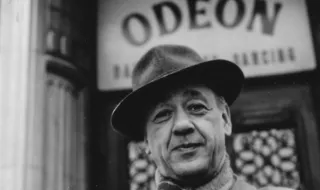
Imagine a stage where an elderly couple arranges dozens of empty chairs for guests who will never appear. Or a small town where the residents turn into rhinoceroses one after another. For Eugène Ionesco, these are not simply strange theatrical inventions. They are a way of showing how language becomes emptied of meaning, while people gradually surrender their own will.
November 26 marks 117 years since the birth of the playwright, who was born in Slatina, Romania. There is a discrepancy regarding the date: the Académie Française gives November 13, 1909, while a number of English-language sources list November 26, 1909. In both cases, the year is 1909. Ionesco was the son of a Romanian lawyer and a Frenchwoman, and spent his early years between Romania and France.
The English Textbook That Became a Play
As a child, Ionesco lived near the Luxembourg Gardens in Paris and spent hours watching puppet shows. Later, he studied French literature at the University of Bucharest, wrote poetry and literary criticism, and in 1938 returned to France to prepare a dissertation. The war interrupted his academic plans, but opened the way to the theater.
His first play, “The Bald Soprano,” appeared in 1950 and was initially received coolly. It is built from clichés, repetitions and conversations that sound grammatically correct but gradually lose all meaning. The idea came from an English-language textbook as Ionesco tried to learn the language. In it, he discovered ready-made phrases that sounded both obvious and absurd.
“The Bald Soprano” was called an “anti-play” by its author and later became one of the foundational texts of the Theater of the Absurd. Together with “The Chairs” and “The Lesson,” it changed the notion of what dramatic action could be. At Paris’s Huchette Theatre, “The Bald Soprano” and “The Lesson” have been performed continuously since 1955, becoming part of the city’s theatrical history.
When the City Begins to Turn into a Herd
The most powerful political image in his work is “Rhinoceros.” In the play, the inhabitants of a city begin turning into rhinoceroses, while almost no one finds the strength to resist. The 1959 play is often associated with Ionesco’s experiences in Romania during the 1930s and with the danger of mass submission to ideologies.
The playwright himself explained to The New Yorker that “the rhinoceros is an animal that moves straight toward its goal without looking either to the left or to the right.” For him, the danger lies not only in political fanaticism but also in the ordinary person’s willingness to abandon doubt in order to merge with the majority. “Theater is the appearance of the unexpected,” Ionesco said in the same interview.
In 1970, Ionesco was elected a member of the Académie Française. Until the end of his life, he wrote about fear, death, loneliness and people’s inability to understand one another completely. He died in Paris on March 28, 1994, but his plays continue to resonate not because they offer ready-made answers, but because they make the audience ask at what point the funny begins to resemble a threat.
Sources: washingtonpost.com, newyorker.com