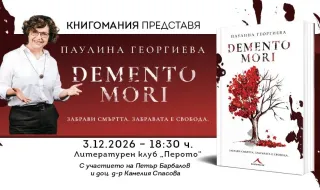
“Demento Mori” – a dystopia about the price we pay when choosing between memory and imagination
What if we save our memory but lose the ability to dream? Paulina Georgieva with “Demento Mori”
In her new dystopia, the author explores two imperfect worlds in which humanity pays a high price for choosing between memory and imagination.
The official launch of Paulina Georgieva’s third novel – “Demento Mori” (published by Knigomania) – will take place on December 3, 2026, at 6:30 p.m. at the Peroto Literary Club in Sofia. The book will be presented with the participation of Petar Barbalov and Associate Professor Dr. Kameliya Spasova.
The novel raises a civilizational question: if we had to choose between memory and imagination, what price would we pay?
“Demento Mori” takes us into the near future, when the nanoplastic accumulated in human bodies causes Pandementia – an epidemic of early-onset dementia. The vaccine that is developed, however, has a side effect – it saves memory but destroys the imagination, condemning society to stagnation. The people of the Community of Nations can no longer dream, create art or invent.
Those who refuse vaccination are relocated to the reserves of the spiritual movement “Demento Mori”, where they live in harmony with nature but are doomed to the Oblivion that gradually overwhelms them. Twenty years later, the Community of Nations launches the “Centuria” program. Young people are selected from the reserves whose preserved imagination is expected to discover a cure for aphantasia. Among them is Ira, the daughter of the healer Daria. She sets out toward a world that remembers everything but can create nothing new.
Two worlds, two losses
The novel takes no sides. The Community of Nations is an orderly, healthy and secure system, incapable of imagining or creating a different future. The reserves preserve rituals, crafts and faith, but slowly and inevitably sink into oblivion, repeating the Latin precepts “Demento Mori. Oblivio libertas est – Forget Death. Oblivion is Freedom.” Neither of the two worlds is a utopia, and the characters pay for their choice with what they value most.
“A person is neither memory nor imagination alone; they exist between what they have been and what they will be,” says Clemente – the leader of the spiritual movement Demento Mori.
“With this novel, I wanted to raise the question not of what we will lose through this choice. I reflected on how difficult it is to bring either of them back – memory or imagination – once we have already lost it,” says author Paulina Georgieva.
The author
Paulina Georgieva is the author of the novels “The Simulation” (Knigomania, 2022) and “Little Sins” (Knigomania, 2024). Her work has received recognition from both critics and major film and literary forums. In 2024, “Little Sins” was selected by the Cinelibri International Film-Literary Festival as a novel with high potential for a film adaptation. That same year, the book was also presented at the Sofia International Literary Festival. In 2025, it was nominated for the Portal Culture National Award.
In 2026, Paulina Georgieva was selected by the European literary platform CELA as an emerging writer whose works have the potential for European distribution. She has been a fellow of the Elizabeth Kostova Foundation, as well as of the international Traduki residency program. Her education in history and psychology lends her writing cultural depth and psychological sensitivity.
Reviews of the book:
“Demento mori” offers a vision of the future shaped by an intelligent and gifted pen. Paulina Georgieva, who has already won readers’ trust with “The Simulation” and “Little Sins”, reveals a reality that, just a decade ago, would have seemed unthinkable. Today, however, we have sufficient reason to ask ourselves: does this reality still seem so impossible?” – Veselina Sedlarska
***
“Demento mori” tells the story of a dystopian world divided in two. The seemingly idyllic reserve in the Balkans is a place where imagination flourishes alongside dementia, while beyond it memory has been preserved at the cost of lost fantasy. The allegorical edges of “Demento mori” crack open, revealing nightmares from our recent pandemic past. Paulina Georgieva confronts us with the philosophical question of whether we are still capable of moving beyond the frameworks in which we have imprisoned ourselves.” – Kameliya Spasova, editor of Literaturen Vestnik
***
“What makes us a society is our resilience both to the unpredictable and to the disasters we create ourselves. “Demento Mori” reminds us that it is precisely our imagination that brings us closer to Creation. All of this can be destructive, but it can also lay the foundations of a new humanity.” – Evgeniya Dineva, writer