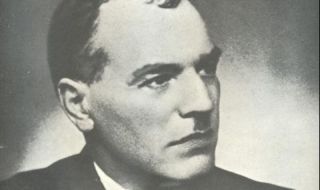
On October 15, 1937, Yordan Yovkov died. Although his entire life and work were connected with Dobrudja, his earthly journey ended in the Catholic Hospital in Plovdiv. He was taken there from Hisarya, where he had gone for treatment. He underwent emergency surgery. Stomach cancer was discovered in an advanced, hopeless state. Also gallbladder cancer, and in addition - appendicitis.
His funeral in Sofia became an expression of popular love and gratitude. He is buried in plot 35 of the Central Sofia Cemetery.
Yordan Yovkov was born on 09.11.1880 in the village of Zheravna, Sliven Region.
He graduated from high school in Sofia, then moved with his family to Dobrudzha, where he worked as a teacher for a long time. He participated in the three wars as a company commander and as a military writer. For some time he was an editor in metropolitan publications. After the occupation of Southern Dobrudzha, Yovkov moved to Varna as a teacher.
After the wars, he was a regular press associate at the Bulgarian legation in Bucharest. Yovkov began his creative path with poems, but during the wars he wrote military essays and stories (Stories. Vol. 1-2. 1917-1918), with which he established himself as a talented storyteller.
His next books are dedicated to life in Dobrudzha (the story "The Reaper", the collections "Last Joy", "Evenings at the Antimov Inn", "A Woman's Heart", the novel "The Farmhouse by the Border") and in his native village of Zheravna ("Stara Planina Legends"). He writes comedies ("The Millionaire") and dramas ("Albena", "Boryana", "Ordinary Man").
He is the author of animalistic prose ("If They Could Talk").
ON THE WIRE
Yordan Yovkov
While he was defending him from the dogs, Petar Mokanina realized that this unknown peasant had not just stopped by, but was being pursued by some kind of trouble. That is why he got angry at the dogs, scolded them and looked at the peasant again; by his red vest you could tell that he was from the Torlaks, from the Deliorman family. He was a tall, big man; but that he was poor and as if he had been born poor - and that was obvious: his shirt was only patches, roughly and ineptly sewn, his belt was torn, his shoes - too. He was barefoot. Otherwise, just look at him - a man of mountains, but Mokanina quickly weighed him in her mind and decided that he was one of those soft, relaxed people who are said to be worth a trip even for an ant.
The peasant greeted, mumbled something like "how are you, are you well", but it was clear that he was thinking about something else and there was another concern in his eyes. And looking somewhere ahead and pointing with his hand, he asked if the village of Mandzhilari was not on this side and how far it would be to get there. Mokanina told him and only then did she notice that a cart with one horse had stopped on the road. The peasant had left this cart to come to him. Inside sat a woman, her hands tucked into her bosoms, folded; her shawl was not covered, but with the ends hanging loose to the sides, so that she could feel comfortable. It was hot - it was hot, but Mokanina knew that when women let their shawls hang loose like that, it was not so much the heat that was bothering them as something else. At the back of the cart, wrapped somewhat in a rug, her head resting on black peasant pillows, lay another woman, smaller, probably a girl. She was looking away and her face was not visible.
- You must be sick, - said Mokanina.
- I am. I have a sick girl.
The peasant looked at the sheep lying in the meadow, kept his eyes on them, but he couldn't see them, and his gaze, full of care, kept wandering.
- She was ours as she is - he said, - leave her!
- You're not from here, where are you from? - Mokanina asked him.
- From Kichuk Ahmed. They call him Nadezhda now, near the Rock. I've been here before. I go around the villages, I sell huma - good huma comes out in our village. It's good, the women buy it. When I go down to the sea, I buy some fish, some grapes, whatever happens. Thank God - we eat. If only this white thing hadn't happened to us...
He sat down on the ground, took out a leather pouch of tobacco, and began to make a cigarette. Mokanina sat down next to him and saw how his thick, calloused fingers trembled as he rolled the cigarette.
- Our children don't last long, - he began. - Two or three of us died young. That's all we have left (he looked at the cart). We've looked at him like our own eyes. I've been saving money to buy him something, to make him clothes, so that he wouldn't be sad when he looks at others. No, God willing, we've kept him until now. And for some time now - he's been pregnant. He's nothing, he's just withering away. I listen, she thought to her mother - she was sad that her friends got married, and she was still standing. "Why are you being so mean, child, I tell her, your luck will run out too. Why are you looking at others? - They are rich. That's how bachelors are these days - they are looking for rich women. You will get married too, mind your own business, you are not too old."
- How old is she?
- About twenty. Now on the Virgin Mary she will be twenty.
- Well, the girl is young.
- Young, well.
The peasant fell silent and looked at the sheep again, without seeing them. Somewhere nearby in the heat a reaper was screaming.
- This summer she begged me to let her go to reap. We are poor, we are in need, but when I saw her so weak, sickly, I didn't feel like letting her go. "Please, Teiko, let me go, I want to go with the girls too." Well, if that's the case, I let her go. Now what happened, I wasn't there, I don't know. They went to bed in the barn, they got up in the barn. I know it the way she told it to me. Once they reaped all day, in the evening they ate, then the girls sang, they laughed. They went to bed. Nonka - that's my girl's name - went to bed too. "I lay down, Teiko, between the sheaves, under a cross, I lay down on a vow, so that it wouldn't blow on me and I wrapped myself up. And I fell asleep. At one point I felt, Kai, something heavy, something cold, right here on my chest. When I opened my eyes: a snake!"
- Oh!
- Well, a snake. It curled up and lay on her chest. She screamed, and with all her fear he grabbed her and threw her away!
- Throwing her away! That's what happens during harvest. I've heard that a snake has even entered a woman's mouth. But if it bit her, it didn't bite her, right?
- No, it didn't. It lay on her chest, picked her up and threw her away! That's what he told me. Whether it was a dream or real - I don't know. Since then the girl has been bad. Oh, she's withered like a twig. Her chest hurts. "Where the snake was, it hurts."
- What a job, what a job! - Mokanina wondered. - What now? To a doctor?
- Doctors: how many doctors have we changed. I'm taking him now... um... how can I tell you... I don't believe it, but they're women, and she's sick, she's a child...
His voice trembled and he fell silent. He stared, needlessly pulling now his mustache, now his beard, unshaven for a long time, stiff, gray with whole tufts of white hair. There was no need for anyone to tell Mokanina that every white hair was a sign of a concern.
- That evening, - the peasant continued, - our people came from the cliff. They said whatever they said - do I know? They're rich people, maybe they're joking. And then Stoenitsa, our godmother, a mouthful, a know-it-all, came running to us. "Guncho, he's calling from the door, you were lucky, Nonka was lucky too. Let her have a good time." "What's up?" - I say. "Nikola and Penyu, the Siderovites, came from the cliff, they say that a white swallow appeared in Mandzhilari... appeared! Absolutely white, like snow." "Well?" "You, kai, do you know what a white swallow is? She, kai, appeared once in a hundred years, no, but whoever sees her, whatever disease they are sick with, gets well! Guncho, kai, go, don't stay. Take Nonka. Oh, can you - the girl cried, his mother got busy. And here we are.
- But is it true? - Mokanina shouted. - Where was that swallow?
- Didn't I tell you, it appeared here, in Mandzhilari.
- White?
- Absolutely white.
Astonished as he was, Mokanina looked back and looked at the road: every day the flock would roost in this same meadow, but it seemed that only now did he notice how many swallows had perched on the telegraph wire. And it was no wonder: the Transfiguration of the Lord was approaching, and at that time the swallows and storks would gather to go. There were so many swallows and they had perched so densely next to each other that the wire was hanging down and heavy like a rosary. Many, but all black.
- That's why I came - the peasant said more boldly and with relief: - I said to ask you, maybe you've seen her, maybe you've heard her...
- I haven't, brother, I haven't. A white swallow? I haven't heard her, nor have I seen her.
But immediately Mokanina realized that she could completely despair these people, and said:
- There might be. Maybe. A white buffalo, a white mouse and a white crow - there are. There might be a white swallow too. And there must be, since it's been heard...
- Who knows? - sighed the peasant. - I'll leave it to me, I don't believe it, but they're women...
He got up to leave. Touched, Mokanina also got up to see him off and see the girl. When they reached the road, the mother - a yellow and heavy-set woman - still looked at her husband from afar, as if she wanted to know from his face what he had learned. The girl was still standing turned away and watching the swallows on the wire.
- The man said that the village was close - said the peasant.
When she heard his voice, the girl turned around. He was weak, his strength, melted by illness, was barely visible from under the blanket, his face was waxen, but his eyes were still bright, still young and smiling. He looked now at his father, now at Mokanina.
- Nonke, that old man saw the swallow - said the peasant and looked at Mokanina. - She was in that village, right! Let's hope we see her too!
- Will we see her, uncle? - the girl spoke and his clear eyes lit up.
Something rose in Mokanina's chest, suffocated him, his eyes blurred.
- You will see her, child, you will see her - he spoke loudly. I saw her, you will see her too. I saw her with my own eyes, white like that, white. You will see her too. May God grant that you see her, child, that you may recover... oh, you are young. You will see her, I tell you that you will see her... and you will recover, child, don't be afraid...
The mother closed her eyes and cried. The tall, large peasant coughed, grabbed the reins of the horse and led him.
- Come on, cheers! - Mokanina shouted after them. - The village is near. All the way, all the way!
He stood on the road for a long time, looking after the cart. He looked at the mother with her black turban, the girl lying next to her, the tall peasant who walked hunched over and led the little horse, and above them, between every two telegraph poles, the swallows flew around, then returned again and landed on the wire.
Pensive, Mokanina returned to his sheep and again set about the little things he was making from unbleached cowhide. "A white swallow," he thought. "Is there one!" But something was pressing against his chest, tormenting him. And when he dropped the awl and looked up at the sky, he cried out:
- God, how much sorrow there is in this world, God!
And he looked after the cart again.