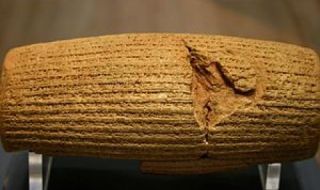
The Persian king Cyrus II the Great conquers Babylon. In honor of his victory, he issues the first written document on human rights, known as the Cyrus Cylinder.
The Cyrus Cylinder or Cyrus Manifesto is a stone cylinder discovered during excavations in Iraq in 1879. It was declared by the Iranian Shah Mohammad Reza Pahlavi in 1960 to be the first written evidence of respect for human rights in history. It is kept in the British Museum.
The artifact also symbolizes tolerance between different peoples and religions. The text inscribed on it describes the victory of the Persian king Cyrus the Great over the Babylonian ruler Nabonidus in 539 BC. Then the Persian troops invaded the Neo-Babylonian Kingdom and put an end to the Semitic rule of the Chaldean dynasty over the world capital. Babylonia was then placed under Persian control.
The cylinder, written in Akkadian cuneiform, tells of Cyrus' conquest, describing him as a peacemaker who brought order and peace to the Babylonians. According to the text, Cyrus II the Great improved the lives of the population of the world capital, restored the temples, erected new ones and strengthened the ruined city wall of Babylon.