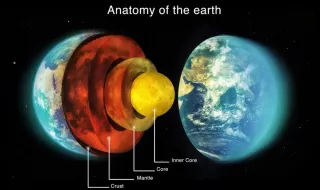
The Earth does not hide a proven “second core“, but seismological data show that its interior is much more complex than the classic scheme with crust, mantle, outer and inner core. Five mysteries continue to divide scientific hypotheses and show how limited direct knowledge of the Earth's deep interior is.
Seismic waves are the main tool with which scientists study inaccessible layers. Their speed and direction change according to the temperature, density, chemical composition and crystal structure of the material they pass through.
Unexplained zones at the base of the mantle
The first mystery is the zones with ultra-low seismic wave velocity, known as ULVZ. They are located just above the boundary between the mantle and the outer core, about 2,900 kilometers below the surface. In them, waves slow down sharply, indicating the presence of material with unusual properties and clearly defined boundaries.
However, their origin remains unknown. Among the possibilities considered are superhot regions, remnants of ancient oceanic crust, parts of Earth's primordial magma ocean, or products of chemical interactions between the mantle and the core.
Also located at the same boundary are two much larger structures called large low-velocity shear provinces, or LLSVPs. One is under Africa, the other under the Pacific Ocean. They extend for thousands of kilometers and reach over 1,000 kilometers vertically. Their origin is also controversial: it is possible that they are mainly hot areas, chemically different accumulations, or a combination of both.
LLSVPs are important for the movement of material in the deep mantle. Some studies suggest that mantle plumes associated with volcanic hotspots may originate at the edges of these structures.
A 520-kilometer boundary with a variable signal
The third mystery lies at a relatively shallow depth – about 520 kilometers. There, the speed of seismic waves changes, but the signal is not as clear and consistent as it should be.
The main explanation is related to minerals in the mantle. Under high pressure, olivine passes through different crystal forms, including wadsleyite and ringwoodite. The transition between them should create a distinct boundary in the seismic data. In practice, however, the signal is weak, variable, and sometimes absent. The possibility of a mathematical artifact and the influence of the deep carbon cycle are discussed.
The inner core is not uniform
The solid inner core has a radius of about 1220 kilometers and is made mainly of an iron-nickel alloy. However, seismic waves travel through it at different speeds depending on the direction - a phenomenon known as seismic anisotropy.
This is usually associated with the orientation of the iron crystals, but the reason for the arrangement itself is not fully understood. Possible factors include core growth, deformation, the planet's rotation, and the interaction between the solid inner and liquid outer cores. New models even consider smaller inner layers and differences in the structure of the core.
What's in the outer core
The fifth mystery is related to the liquid outer layer of the core. It is less dense than it would be if it were composed only of iron and nickel. Therefore, scientists allow the presence of lighter elements - sulfur, silicon, oxygen, carbon and hydrogen.
There is still no consensus on which of them predominate and in what quantities. The answer is important because the chemical composition affects the density, motion and electrical properties of the outer core, and hence the operation of the geodynamo - the process that maintains the Earth's magnetic field.
Source: Actualno.com