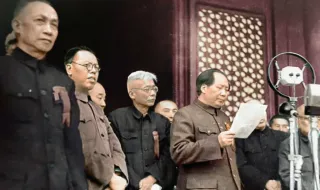
On October 1, 1949, Tiananmen Square in Beijing became the scene of an event that changed the history of China and the political balance in Asia. In front of more than 300,000 people, Mao Zedong proclaimed the establishment of the People's Republic of China.
Mao spoke from the podium above the Tiananmen Gate at around 3:00 p.m. local time. In his proclamation, he declared: “The Central People's Government of the People's Republic of China is established today!“ This was followed by the raising of the five-star flag, the performance of the “March of the Volunteers“, a military parade, and a procession. October 1 was declared a national holiday for the new state.
Victory after years of war
The proclamation of the PRC came after a long and destructive conflict between the Chinese Communist Party and the Kuomintang, or Chinese Nationalist Party. The two forces had been engaged in a civil war at various stages since 1927, and after the end of World War II, fighting resumed in full force in 1946.
Mao's communists had strong support among the rural population, an established military organization, and positions strengthened during the fight against the Japanese occupation. Chiang Kai-shek's Nationalist government was weakened by corruption, economic crisis, and loss of public trust. According to the U.S. State Department, in 1947–1949, a communist victory became increasingly likely after a series of military successes.
A few days before the ceremony, on September 21, 1949, Mao announced the establishment of the People's Republic of China at the first plenary session of the Chinese People's Political Consultative Conference. The session adopted the basic documents of the new government, elected Mao as chairman of the Central People's Government, and designated Beijing as the capital.
The beginning of the Beijing–Taiwan split
On October 1, the civil war had not yet fully ended in all parts of the country. Communist forces controlled most of mainland China, but Nationalist troops continued to retreat south. At the end of 1949, the government of the Republic of China moved its headquarters to Taipei, and Chiang Kai-shek and his supporters settled on Taiwan.
This formed the political division that continues to this day: the People's Republic of China ruled the mainland of the country, while the Republic of China retained its rule over Taiwan. The proclamation of the PRC also laid the foundation for new relations between China, the Soviet Union, and the United States at the beginning of the Cold War.
For the Chinese Communist Party, October 1 remains a symbol of the victory over the Nationalists and the creation of the modern Chinese state. In the following decades, the country underwent large-scale political campaigns, severe economic experiments, and profound social changes, but the date of 1949 continues to be the starting point of the official narrative of the People's Republic of China.
Sources: en.theorychina.org.cn, history.state.gov