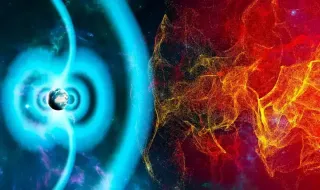
The Earth's magnetic field remains restless on October 5, after several days of increased solar activity. In the early hours, the geomagnetic index Kp reached a value of about 5, which means a weak magnetic storm of class G1.
The cause comes from the Sun. As early as October 3, a coronal mass ejection reached the Earth, followed by a fast flow of solar wind. On October 4, it intensified the disturbances in the Earth's magnetic field to category G2, and the effect continues to be felt today.
Although the expression “magnetic storm“ sounds alarming, the current situation is not extraordinary. G1 is the lowest level on the US NOAA's five-level geomagnetic storm scale, while G2 is defined as a moderate storm.
Such activity may cause brighter auroras and slight disruptions to some satellites, navigation systems, and power grids. For most people, the phenomenon goes unnoticed.
Interestingly, the strongest phase of the current episode was actually on October 4, when Kp reached values of around 6. On October 5, the activity continued, but there is currently no evidence of a transition to a strong or extreme geomagnetic storm.
The Sun is still in an active period of its approximately 11-year cycle, so such events are not surprising. However, this does not mean that the whole of October will necessarily be a month of magnetic storms.
Scientists can track what is happening on the Sun relatively well, but the exact strength of a geomagnetic storm often becomes clear only when the stream of solar particles approaches the Earth. Therefore, long-term calendars that indicate in advance "dangerous days" with magnetic storms for the entire month should be taken with caution.
As of October 5, the forecast remains relatively calm: the Earth is going through a period of increased geomagnetic activity, but there is no reason for alarm. The more interesting effect may be in the sky, where, under suitable conditions, solar activity increases the chances of observing auroras at lower latitudes than usual.