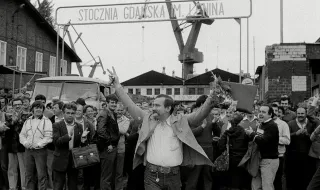
On October 8, 1982, the Sejm of the Polish People's Republic passed a law that formally dissolved all trade unions that existed before the introduction of martial law. Among them was “Solidarity“ - the first independently organized and officially recognized trade union in a communist state.
The decision was made during the government of General Wojciech Jaruzelski, ten months after the authorities declared martial law in the country. The law was adopted with 12 votes “against“ and 10 abstentions. It annulled the registration of “Solidarity“ and sets new rules for trade union activity.
From a legal union to an illegal network
„Solidarity“ emerged after the strikes at the Gdańsk shipyard in August 1980 and was registered by the Supreme Court of Poland on November 10 of the same year. In a short time, the organization became a mass social movement. By the end of 1981, it had about 9-10 million members - workers, intellectuals and representatives of various social groups.
This was the first time that a communist state officially recognized an independent trade union capable of representing workers outside the control of the ruling party. The movement was led by the electrician from Gdańsk, Lech Walesa, who later became President of Poland.
On December 13, 1981, Jaruzelski introduced martial law. Leaders of “Solidarity“ were interned, strikes and public meetings were restricted, and the union's activities were suspended. Lech Walesa was arrested, and independent structures went underground.
The law that was to replace “Solidarity“
The new law allowed the creation of trade unions at the enterprise level, but postponed the creation of a national federation until early 1985. Only one trade union could operate in a given enterprise for the first three years. Political and solidarity strikes are banned, and the courts are given the power to dissolve organizations that are determined to be contrary to the constitution.
During the debates, MP Janusz Zabłocki accused the authorities of not restoring the independent union, but destroying it:
„This law does not aim to restore „Solidarity“, but to liquidate it.“A representative of the government defended the measure with the argument that the return of „Solidarity“ would mean the restoration of a political opposition that, according to the authorities, threatens state unity.
Protests and continuation in illegality
The dissolution sparked protests in a number of cities. In Gdańsk, about 270 people were arrested. In Nowa Huta, near Kraków, clashes between demonstrators and security forces continued for hours. On October 13, 20-year-old worker Bogdan Wlosik was killed. Demonstrations also took place in Wrocław, where protests continued late into the night.
Although the law abolished “Solidarity“ as a legal organization, the movement did not disappear. Underground structures continued to distribute printed materials, organize strikes, and maintain contacts between workers. Martial law was finally lifted on July 22, 1983, but political restrictions remained.
In 1989, “Solidarity“ was again granted legal status after the Round Table negotiations. At that time, its legalization was already part of the transition to a multi-party system and free elections – a process that transformed the former trade union into a major political force at the end of the communist era.
Sources: washingtonpost.com, historia.interia.pl