Margaret Hamilton, the computer pioneer who led the development of software for the “Apollo“ missions, died on September 30, 2026 at the age of 90. Her death was confirmed by the Massachusetts Institute of Technology, but the cause was not reported. A memorial service will be organized in the spring in Cambridge, Massachusetts, reports the New York Times.
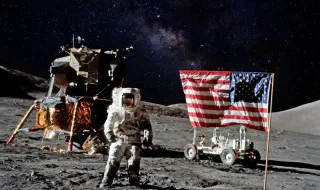
Hamilton remains in history with her work on the on-board software of the “Apollo“ spacecraft - the systems that manage navigation, guidance and landing. She led the teams at the Massachusetts Institute of Technology Instrumentation Laboratory that developed the software for the command and lunar modules.
In the critical minutes before the landing of „Apollo 11“ in July 1969, the on-board computer issued alarms 1201 and 1202. The system was overloaded with additional signals, but the software was designed to stop lower-priority tasks and save resources for the most important operations.
“It became clear that the software was not only reporting a hardware problem, but also compensating for it - rebooting the system and restoring the highest-priority tasks“, Margaret Hamilton said in an interview quoted by „The Guardian“. Thus, the Mission Control Center allowed the landing to proceed.
Later, President Barack Obama referred to this episode when he awarded Hamilton the Presidential Medal of Freedom - the highest civilian honor of the United States - in 2016.
“Our astronauts didn't have a lot of time, but fortunately they had Margaret Hamilton“, Obama said at the time.
The first female programmer on the “Apollo“ project
Margaret Hamilton was born in 1936 in Paoli, Indiana. She graduated from “Earl“ College with a degree in mathematics in 1958, then moved to Boston. At the Massachusetts Institute of Technology, she initially worked on weather forecasting programs with meteorologist Edward Lorenz.
In 1961, she joined Lincoln Laboratory, where she developed software for the U.S. Air Defense System. In 1965, she was hired as the institute's first programmer and first female programmer for the Apollo program. By 1968, more than 400 people were working on the program's software under her supervision.
Her work also helped establish the term "software engineering." "When I first started using that term, no one had heard of it," Hamilton says. For years, the term was considered a joke, but gradually software gained the status of an independent engineering discipline.
Career after NASA
Margaret Hamilton left the Massachusetts Institute of Technology in the 1970s. In 1976, she founded the company Higher Order Software, and ten years later created Hamilton Technologies. In her work, she continued to develop methods for preventing errors and creating reliable complex systems.
In addition to the Presidential Medal of Freedom, she received NASA's “Exceptional Space Act Award“ in 2003, recognition from the Computer History Museum in 2017, and was inducted into the National Aviation Hall of Fame in 2022.