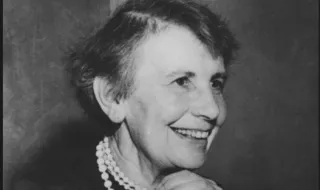
October 9 marks the 44th anniversary of the death of Anna Freud – an Austrian-British psychoanalyst, one of the most influential figures in the history of child psychology. The youngest daughter of the founder of psychoanalysis Sigmund Freud managed to build an independent scientific career and change the way specialists research the emotional development and psychological problems of children.
Anna Freud died on October 9, 1982 in London at the age of 86, leaving a significant legacy in the fields of psychoanalysis, child psychotherapy and developmental psychology.
Anna Freud's childhood – life in the shadow of the famous fatherAnna Freud was born on December 3, 1895 in Vienna. She was the sixth and youngest child of Sigmund and Martha Freud.
Although she grew up in a family where psychology and human behavior were a constant topic of conversation, her childhood was not always happy. Anna had a complicated relationship with her mother and often felt neglected compared to her older siblings.
From an early age, she showed a strong imagination, an interest in literature, and a tendency to introspection.
She initially chose the teaching profession. In 1914, she began pedagogical training, and working with children gradually directed her interests towards their emotional and mental development.
A curious fact is that Sigmund Freud himself conducted a psychoanalysis of his daughter. This practice, now considered a serious ethical problem due to their family relationship, had an impact on her professional development.
The woman who turned child psychoanalysis into a separate fieldWhile Sigmund Freud mainly studied the mental life of adults, Anna Freud focused her attention on children.
She was among the pioneers who systematized the methods of child psychoanalysis and adapted them to the specifics of child development.
According to her, the child cannot be viewed as a miniature adult. His reactions, fears, fantasies and defense mechanisms must be analyzed in the context of age, family environment and stage of development.
Anna Freud emphasizes the importance of trust between the child and the therapist. Unlike adults, children do not usually seek psychological help of their own free will, which necessitates a different approach.
In her work, she uses observation, conversations, drawings, and various forms of free expression.
Her ideas have had a lasting influence on the development of child psychotherapy, although some of the classic psychoanalytic concepts remain the subject of scientific debate today.
The defense mechanisms of the psyche - one of her great contributionsIn 1936, Anna Freud published one of her most significant works - – “The Ego and the Defense Mechanisms“.
In it, she systematizes the ways in which the human psyche tries to protect itself from anxiety, internal conflicts, and painful experiences. Among the defense mechanisms examined are repression, projection, regression, reaction formation, and rationalization. For example, a person may unconsciously attribute their own unacceptable feelings to others - a mechanism known as projection.
In regression, the individual reverts to behavior characteristic of an earlier stage of development. This can be observed in a child who, after the birth of a younger sibling, begins to exhibit behavior typical of a younger age again.
Although the concept of defense mechanisms originated in the works of Sigmund Freud, Anna Freud made a significant contribution to its systematization and development.
The Second World War changed the direction of her workIn 1938, after Austria's annexation by Nazi Germany, the Freud family left Vienna and settled in London.
During World War II, Anna Freud worked with children who had experienced bombings, separation from their parents, and other traumatic events.
Together with her close collaborator Dorothy Burlingham, she organized children's centers known as the Hampstead War Nurseries.
Their observations showed how essential stable emotional bonds and adult care were for the mental development of the child.
Their work contributes to the understanding of the consequences of early separation, loss and emotional deprivation.
She never married and had no children of her ownOne of the curious facts in Anna Freud's biography is that she never married and had no children of her own, although she devoted almost her entire professional life to their development and well-being.
Her closest collaborator and long-time companion was the American psychoanalyst Dorothy Burlingame. The two lived and worked together for decades. The nature of their personal relationship is the subject of various biographical interpretations.
Anna Freud remained strongly attached to her father and cared for him in the last years of his life, when he suffered from oral cancer.
After his death in 1939, she continued her scientific work, gradually establishing herself as one of the leading representatives of the psychoanalytic movement.
Anna Freud's legacy continues todayIn 1947, Anna Freud and Kate Friedlander established a program for training child psychotherapists in London. Five years later, a specialized children's clinic was added to it.
This activity laid the foundations for an institution that later became known as the “Anna Freud“ Center.
In 1965, she published the book “Normality and Pathology in Childhood“, in which she examined the different lines of mental development and the possibilities for assessing child behavior.
Her work contributed to the understanding that psychological difficulties in childhood should be assessed not only through individual symptoms, but also in relation to the overall development of the child.
Anna Freud received numerous academic honors, including honorary doctorates from prestigious universities.
In 1986, the Freud family home in London was converted into a museum that preserves the personal belongings, library, and scientific legacy of Sigmund and Anna Freud.
Today, 44 years after her death, Anna Freud's name remains associated with the development of child psychoanalysis and with the idea that understanding childhood experiences is an essential part of mental health care.
Her contributions go beyond her famous surname. Anna Freud left her own mark on the history of psychology, transforming childhood into an independent and significant object of psychological research.