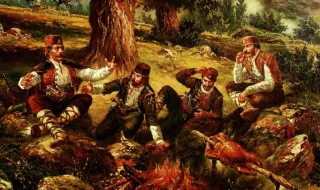
The history of the Bulgarian lands preserves the memory of one of the most significant phenomena of resistance – the haidut movement. Today we look back to the roots of this movement to understand how a handful of brave men and women managed to oppose a powerful empire. This is not just a story about battles, but a story about strict laws, traditions and incredible courage.
Who were the outlaws and what was their motivation?
Contrary to some romantic notions, the outlaws were not professional soldiers, but ordinary people torn from their peaceful lives. Studies by the Institute for Historical Research show that the majority of them were peasants, shepherds, craftsmen, and sometimes literate people - teachers or priests.
The motivation for going "into the forest" was most often personal and emotional, later developing into a folk cause. The main motivations included:
Admission to the detachment: A test of spirit and body
Entry into the hajduş company was extremely difficult and went through a strict screening process. The voivodes were aware that one weak or corrupt person could ruin the entire squad. The selection process included several key stages:
Recommendation: The candidate (called a “novice“ or “hero“) rarely went into the forest alone. Usually he was sent by a trusted yatak or brought by an active haidutin who vouched for him with his life. Character test: The person's past was checked - whether he was honest, whether he could keep a secret and how he behaved under pressure. Physical tests: The novices were subjected to severe tests of endurance, strength and agility. They were forced to run long distances in full combat gear, jump over obstacles, and starve for days to test their willpower. Shooting and Weapon Handling: It was checked whether the candidate had an accurate aim and whether he could use a knife and a rifle. Those who did not have the skills underwent intensive training in the detachment camps.The Oath of Panayot Hitov: How do heroes swear?
The historical memoirs of the legendary Panayot Hitov reveal the true gravity of the haidush ritual. The documents of the Regional History Museum in Sliven describe how the new Chetniks approached the campfire in complete silence.
The candidate had to kneel before an improvised altar of crossed daggers and a revolver placed on a holy gospel. The voivode recited the words of the oath, and the novice repeated them with his right hand on his heart. The ritual ended with kissing the weapon and the flag. From that moment on, the outlaw crossed out his previous life and belonged only to the forest and his brothers-in-arms.
Organization and hierarchy: Who commands in the forest?
After passing the tests, the candidate became a full member of the detachment, which was a strictly organized military unit. The voivode headed each detachment. His word was law, and his election was carried out with absolute unanimity by the Chetniks. The voivode had to possess exceptional qualities - physical strength, strategic thinking, fair character and authority.
The second most important person in the detachment was the bayraktar (standard bearer). He carried a silk banner, often embroidered with a lion and the words "Freedom or Death". The bayraktar was the voivode's right hand and took command if the leader was wounded or killed. According to historical research by the Bulgarian Academy of Sciences, discipline in the detachment was harsher than that in a regular army.
Living conditions and food: Life under the open sky
The life of the haiduts was filled with constant deprivation. Their home from spring to autumn was the forest ("mother protector"). They slept on the ground, covered with yamurluks, often in the rain and snow.
Food: Their main diet consisted of dry bread, bacon, onions, garlic, and dried meat. Contrary to myths, they rarely roasted lambs on a spit, so that the smoke would not give away their location. Yatats: A huge role in their survival was played by the Yatats – local villagers who supplied them with information, bread, clothes and gunpowder. Wintering: In winter, when the forest thins and tracks in the snow are easily traced, the Chetniks would disband. The Chetniks would hide with loyal Yatats or cross into neighboring countries such as Wallachia and Serbia.Traditions, customs and fraternization
In addition to the oath, one of the most interesting customs was that of fraternization. The Haiduts believed that the bond between brothers was stronger than blood. The ritual involved mixing drops of blood or symbolically sipping from a common cup. They also shared a number of superstitions – they believed in omens, dreams, and looked for signs in nature before going into battle.
The Harsh Law: Punishments and Relations
Internal relations were based on absolute honesty and equality. The booty was divided equally, with part of it always set aside for poor families, widows, or for buying weapons.
The laws of the forest were merciless towards traitors and violators of morality:
For lying or stealing from a comrade - physical punishment or banishment. For falling asleep on a fast or betraying - the only punishment was death. Attitude towards women: The outlaws observed strict morality. Violence against civilians was absolutely forbidden, and the honor of women was protected at the cost of life.Legendary heroes and their battles
Bulgarian folklore and documents from the State Agency “Archives“ preserve the names of dozens of notable voivodes.
Chakar Voevoda: Known as the “Samokov protector“, he controlled Rila and the Iskar Gorge, successfully defeating a number of Ottoman forces. Indje Voevoda: A symbol of the transformation from a Kardzhali chieftain to a national protector. His detachment operated in Strandzha and Sakar. Women Voevodas: We should not forget the brave women like Sirma Voevoda and Rumena Voevoda, who led male detachments with an iron fist and proved that the will for freedom has no gender.From haidutism to Rakovski and Botev: The Evolution of the Struggle
Haidutism did not remain an isolated phenomenon. It became the solid foundation on which later ideologists of the national liberation movement stood. Georgi Stoykov Rakovski was the first to see that haidutism's manifestations had to be channeled. He transformed the spontaneous haiduk bands into an organized military force through his “Plans for the Liberation of Bulgaria“.
Later, Hristo Botev celebrated this feat and himself turned the haiduk ideal into reality, leading his band across the Kozloduy coast. The haiduk movement grew from personal revenge into a coordinated national revolution that prepared the ground for the April Uprising and the birth of a free Bulgaria.
The Fate of the Survivors: The Bitter Taste of Freedom
After the Liberation in 1878, the fate of the few surviving old voivodes and chetniks turned out to be dramatic and often paradoxical. Accustomed to the harsh law of the jungle and absolute justice, many of them had difficulty adjusting to the new state bureaucracy and political struggles. Most remain out of the spotlight, sinking into poverty and oblivion.
Legendary figures such as Ilyo Voevoda (Grandpa Ilyo) and Panayot Hitov still manage to make their contribution to New Bulgaria, participating in the Serbo-Bulgarian War and the Kresna-Razlog Uprising. Others, however, disappointed with the new customs, isolate themselves completely. The state grants modest champion pensions to a few, leaving most of these living monuments of courage to live out their days in solitude.
Captain Petko Voivoda: The Legend of Thrace
Speaking of legendary defenders, we cannot ignore the figure of Captain Petko Voivoda (Petko Kiryakov). His activities encompassed the Aegean Thrace and the Rhodope Mountains, where he became a real nightmare for the Ottoman authorities and a defender of the entire Christian population. Petko Voivoda is unique in that his struggle went beyond the scope of ordinary banditry - he received military education in Greece, participated in the Cretan Uprising and collaborated with the Italian revolutionary Giuseppe Garibaldi, which earned him the title of "captain".
After the Liberation, his fate embodied the tragedy of many deserving Bulgarians. Instead of honors, because of his political beliefs and his opposition to the regime of Stefan Stambolov, he was persecuted, interned and even imprisoned in the Black Mosque. Despite the bitterness and injustice, Captain Petko Voyvoda remains in history as one of the purest and most revered images of the popular resistance.
The Testament Written in Blood
The banditry remains in Bulgarian memory as the most romantic, but also the harshest period on the road to freedom. It was the rebellion of the irreconcilables – of those who chose the cold embrace of the Balkans over the obediently bowed head. Today, centuries later, their battles are not just pages from dusty archives, but a powerful moral compass. The bandits proved that freedom is not obtained for free; it is won at the cost of dozens of deprivations, iron discipline and boundless love for the fatherland.