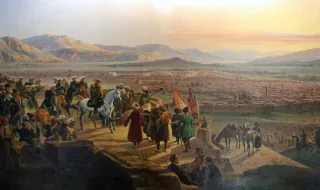
On October 9, 1878, the Russian Empire takes over the administration of Southern Bessarabia from Romania. At that time, the region was home to about 103,000 Bulgarians, distributed in two towns and nearly 70 villages, among which Bolgrad occupies a leading place.
The change of power is the result of the decisions of the Berlin Congress, which revised the Treaty of San Stefano after the Russo-Turkish War of 1877-1878. Southern Bessarabia was returned to Russia, and Romania received Northern Dobrudja as compensation. Thus, the Bulgarian population on both sides of the Danube remained outside the borders of the newly liberated Principality of Bulgaria.
Bulgarian Community on the Danube
The mass settlement of Bulgarians in Bessarabia began in the late 18th and early 19th centuries. After the Russo-Turkish Wars, entire families left the Bulgarian lands and settled in the southern part of the Russian Empire. The settlers were granted land and privileges that helped build sustainable agricultural and commercial communities.
Bolgrad gradually became the center of Bulgarian social and cultural life. The city was associated with the Bolgrad Gymnasium, which prepared future public figures, politicians and educators for the restored Bulgarian state. Schools, church communities, and local forms of self-government developed among the Bessarabian Bulgarians.
A territorial exchange with far-reaching consequences
The return of Southern Bessarabia to Russia restored the border that existed before the Paris Peace Treaty of 1856. Then, after the Crimean War, Russia ceded the region to Moldova, which in 1859 united with Wallachia and laid the foundations of Romania.
The 1878 decision had consequences not only for the states, but also for the people living in the disputed territory. The Bulgarians in Southern Bessarabia again fell under Russian rule, while other Bulgarian communities were left in Romania, the Ottoman Empire or outside the borders of the Principality of Bulgaria.
“The Treaty of Berlin divided the Bulgarians into five parts“, writes the writer, historian and journalist Georgi Pashev in his documentary story about the Unification, quoted by the Bulgarian National Radio.This division determined the fate of the Bulgarian communities for decades to come. The Bessarabian Bulgarians preserved their language, religion and local memory, but the political borders around them continued to change. The history of Southern Bessarabia remains one of the examples of the consequences of the decisions of the great powers on a population that did not directly participate in the negotiations that determined its future.
Sources: archives.bnr.bg, new.bnr.bg, hiclub.bg