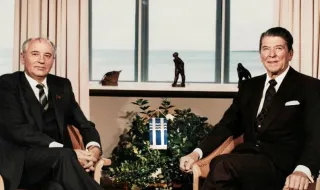
In the small Höfdi house near Reykjavik on October 11, 1986, one of the most unusual meetings in the history of the Cold War began. US President Ronald Reagan and Soviet leader Mikhail Gorbachev meet not for a formal ceremony but for talks that gradually lead to the previously unthinkable idea of eliminating nuclear arsenals.
The meeting was intended as a brief attempt to move negotiations forward after the two leaders first met in Geneva in November 1985. Instead, the talks on October 11 and 12 turned into intense negotiations about the future of US and Soviet nuclear weapons.
Proposal for a 50% reduction
Gorbachev proposes that the strategic offensive weapons of the United States and the Soviet Union be reduced by half. The proposals also included the removal of American and Soviet intermediate-range missiles in Europe, as well as the opening of talks on shorter-range missiles.
During the negotiations, the two sides discussed an even broader goal - the complete elimination of ballistic missiles within ten years. In his speech after the meeting, Reagan stated: “We have proposed the complete elimination of all ballistic missiles - Soviet and American - from the face of the Earth by 1996.“
This was not a negotiated agreement, but an American proposal that remained on the table. On a number of other points, the two leaders reached agreement in principle, including a 50 percent reduction in strategic arsenals within five years. The plan calls for weapons to be reduced to 1,600 carriers and 6,000 warheads for each side.
„Star Wars“ stops the deal
The negotiations collapsed because of the Strategic Defense Initiative - the American missile defense program announced by Reagan in 1983. The project, called „Star Wars“ by critics, includes the development of technologies for intercepting missiles, including in space.
Gorbachev was ready to accept that research should continue in laboratories, but insisted that testing outside them be limited. Reagan refused, believing that such a condition would block the development of the program. Thus, the issue of missile defense turned out to be connected with all other agreements on the reduction of nuclear weapons.
On October 12, the meeting ended without a signed document. Gorbachev later described it as “not a failure, but a breakthrough“, because for the first time the two leaders discussed in detail the possibility of a world without nuclear weapons. Reagan also stated that the possibility of starting a process to eliminate the nuclear threat remained open.
The path to treaties
Reykjavik did not bring an immediate treaty, but the talks changed the framework of relations between Washington and Moscow. On December 8, 1987, Reagan and Gorbachev signed the Treaty on the Elimination of Intermediate-Range and Shorter-Range Missiles – the first agreement to eliminate an entire class of nuclear weapons.
Four years later, START I laid the groundwork for reducing strategic nuclear arsenals. The Reykjavik meeting therefore remains both a failed attempt at an immediate agreement and an important step toward the real treaties that began to limit nuclear confrontation at the end of the Cold War.
Sources: history.com