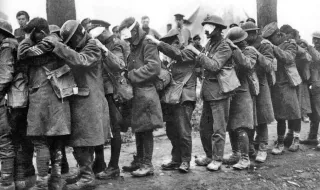
In the trenches near Ypres, the soldiers initially felt almost nothing. There was no green cloud that they already knew from chlorine attacks, nor immediate suffocation. Hours later, however, the skin began to blister, the eyes became inflamed, and breathing became torture. Thus, in 1917, the First World War encountered a new chemical weapon - mustard gas.
It is important to specify the date: the first use of mustard gas by Germany was not on October 12, 1917. The German army fired it for the first time on the night of July 12-13 near Ypres in Belgium. The weapon was aimed at British positions and was delivered with artillery shells marked with a yellow cross.
Mustard gas does not kill immediately
The substance is known as sulfur mustard, mustard gas or yperite - a name related to the French name for Ypres. Despite the popular name, it is not a gas in the strict sense, but a volatile oily liquid that can disperse in the air and remain on the ground, clothing and military equipment.
Its most insidious property is its delayed action. Exposed soldiers often do not immediately realize that they have been hit. After a few hours, painful burns, blisters, severe eye damage and damage to the respiratory tract appear. A gas mask can protect the lungs, but it does not completely protect the skin. Therefore, mustard gas was used not only to kill, but also to remove large groups of soldiers from the battlefield.
According to data compiled by the Organization for the Prohibition of Chemical Weapons, chemical agents caused more than one million casualties and over 90,000 deaths during the First World War. Mustard gas is particularly important because it remains active longer than many of the agents used before it and turns entire sections of the front into a dangerous zone.
October 12 - the day of mud and victims
On October 12, 1917, the events near Passchendaele show how chemical warfare fits into the larger tragedy of the Third Battle of Ypres. Heavy rains had turned the battlefield into deep mud, artillery had broken up the roads, and the German defences were largely intact.
The New Zealand Division attacked Bellevue Ridge, but the attack failed. The two Anzac brigades suffered over 2,700 casualties – killed, wounded and missing. For New Zealand, this remains the worst single-day assault in the country's history.
Mustard gas was not the cause of all the casualties that day, but it was present in the same battlespace where rain, artillery fire and mud made every step a test. By November 6, the Allies had captured Passchendaele, but the offensive had cost hundreds of thousands of lives on both sides.
In 2017, German Foreign Minister Sigmar Gabriel declared: “This unimaginable suffering must never be forgotten.” His words bring back the true meaning of the date - not to a technological innovation on the battlefield, but to a moment when war began to leave behind invisible mines, burned bodies, and pain that did not end with the end of the battle.
Sources: sciencehistory.org, circulatingnow.nlm.nih.gov, nzhistory.govt.nz