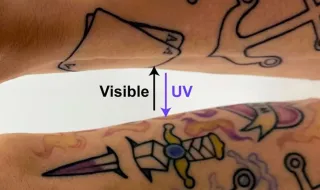
Imagine a tattoo that does not have to be removed to disappear from sight. Scientists at the University of Colorado are developing a photochromic ink that can be “turned on“ with ultraviolet light and made almost invisible with bright visible light.
The technology is called PhotoTat. According to Carson Bruns, one of the researchers, the change can be repeated many times. “The tattoo is permanent, but its appearance – not“, he explains.
Bruns himself already wears such a tattoo in the form of fish scales. It has been on his skin for more than two years, and he has not noticed any obvious fading or known side effects. “When you don't want to see it, you just turn it off“, says the scientist.
How photochromic ink works
PhotoTat uses photochromic dyes – substances that change color when exposed to light of a certain wavelength. Ultraviolet light activates the pigment, and bright visible light returns it to an almost transparent state.
The placement mechanism is similar to that of ordinary tattoos. The pigment particles are introduced into the dermis with a needle and remain there permanently. The main difference is in the pigment itself, not in the machines or tattooing technique. So far, the technology has also been demonstrated on silicone materials.
The development offers 16 distinguishable colors, from which at least 300 shades can be obtained. White ink is currently missing, since white reflects light instead of absorbing it. Researchers have yet to achieve a true cyan color.
Possible application in radiation therapy
One potential medical use involves markings that doctors place on patients' skin to guide radiation therapy. With PhotoTat, such markings could be hidden when they are no longer needed, rather than remaining permanent.
However, the technology has limitations. Blue inks can gradually turn a persistent purple hue after repeated exposure to light. In addition, people with such a tattoo would need to use sunscreen to prevent the image from being activated by sunlight.
The polymer in which the dyes are embedded is non-toxic and has long been used in permanent biomedical implants. However, the toxicity of the photochromic inks themselves is still unclear.
Signe Bedsted Clemensen of the University of Southern Denmark warns that the ink remains a foreign substance in the body, regardless of whether it is constantly visible. According to her, the health concerns associated with traditional tattoos probably also apply to invisible inks. More safety studies are needed before PhotoTat becomes widely available.
Sources: unian.net