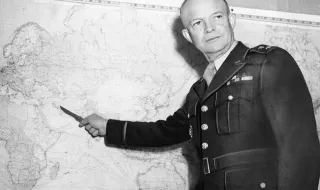
On October 14, 1890, the man who would later command the Allied armies during the Normandy landings and become the 34th President of the United States was born in Denison, Texas. His birth name was David Dwight Eisenhower, and he was the third of seven sons in the family. Two years later, the Eisenhowers moved to Abilene, Kansas - the city with which the future general and president associated his identity.
Eisenhower graduated from the Military Academy “West Point“ in 1915, and the following year he married Mamie Dodd. His military career progressed particularly rapidly during World War II. As Supreme Allied Commander in Europe, he led the preparations for Operation Overlord - the Normandy landings on June 6, 1944, which opened the Western Front against Nazi Germany.
In his order to the troops, Eisenhower wrote: “The tide has turned! The free people of the world are marching together to victory!“ The operation brought together Allied land, sea, and air forces and became one of the decisive moments of the war.
From NATO command to the White House
After the war, Eisenhower was president of Columbia University, and in 1951 he became the first Supreme Allied Commander of NATO. In 1952, he ran for president as a Republican and won the election. He took office on January 20, 1953, and served two terms until January 20, 1961.
His presidency spanned the Cold War, tensions with the Soviet Union, and the Korean War. In July 1953, an armistice was signed that ended active hostilities on the Korean Peninsula, but no final peace treaty was reached.
Among Eisenhower's most enduring decisions was the 1956 Act that established the American Interstate Highway System. During his administration, the federal government also took more active action to protect the decision to desegregate. In 1957, Eisenhower sent federal troops to Little Rock, Arkansas, to ensure access to Central High School for black students. In 1958, he signed the law creating NASA - a response to the new space race after the launch of the Soviet "Sputnik".
The warning at the end of the term
In his farewell address to the Americans in January 1961, Eisenhower warned about the influence of the military-industrial complex - the alliance between the military industry and political power. After leaving the White House, he retired to his farm near Gettysburg, Pennsylvania.
Dwight Eisenhower died on March 28, 1969, in Washington, D.C., at the age of 78. His legacy remains linked simultaneously to the largest Allied operation of World War II, the construction of the American road network, and key decisions at the dawn of the space age.
Sources: apnews.com, time.com, latimes.com