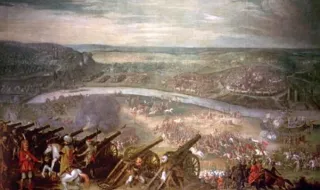
On October 14, 1529, the army of Sultan Suleiman I launched its last major assault on Vienna, but the defenders managed to repel it. This was the decisive moment in the first Ottoman siege of the city, which began on September 27 of that year.
Suleiman I reached Vienna after the victory at Mohács in 1526, which marked the beginning of a new phase in the struggle between the Ottoman Empire and the Habsburgs for control of Hungary and Central Europe. After the capture of Buda in September 1529, the sultan directed his army towards the capital of the Austrian dominions.
The siege was plagued by time and logistics
The size of the Ottoman forces is estimated differently by historians. Modern reference sources indicate between 80,000 and 120,000 men, while estimates of the garrison of Vienna range from around 18,000 to 25,000 soldiers. The defense was organized by Niklas Count of Salm and Wilhelm von Roggendorf.
However, the march to the city was delayed by heavy rains, muddy roads and difficult terrain. Some of the heavy siege artillery failed to reach Vienna. According to Encyclopedia.com, it was the lack of sufficiently heavy artillery that limited the Ottomans' ability to breach the fortifications.
Ottoman sappers dug tunnels and laid mines under the walls, but the defenders discovered and defused most of them. When individual explosions managed to open gaps, the city's infantry met them with long pikes and arquebuses.
The Last Assault
After prolonged rainfall, the situation in the Ottoman camp deteriorated. Food and water shortages, disease, and the approaching winter put Suleiman's army under pressure. On October 12, a military council was convened, at which it was decided to make another attempt to capture the city.
Two days later, the Ottomans attacked in several places. The attack failed to widen the gaps in the walls, and the defenders held their ground. The historical reference of TheCollector lists October 14 as the day of the final assault, and October 15 as the date on which Suleiman ordered a retreat.
Therefore, both dates are found in historiography for the end of the siege. Some sources identify October 14 as the day on which the Ottomans lifted the siege after the failure of the last attack, while others place the official beginning of the retreat on October 15.
The Municipality of Vienna summarized the consequences of the event with the words: “Vienna was not conquered, but the siege had a dramatic impact on the physical appearance of the city.“ After 1529, the medieval walls began to be replaced and reinforced with more modern fortifications and bastions.
The First Siege of Vienna stopped the Ottoman advance into Central Europe, but did not end the conflict. In 1532, Suleiman I launched a new campaign, which did not end with a second attack on the city.
Sources: thecollector.com, encyclopedia.com