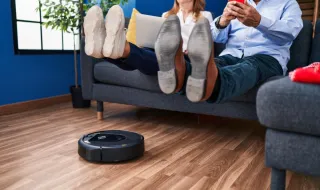
A robot vacuum cleaner does not start from a blank slate. It must move on a specific floor, pass through doors, go around furniture and return to its charging station. Therefore, the most sensible preparation begins not with choosing a brand, but with a short tour of the home with a tape measure.
First, free the floor from cables, chargers, shoelaces, clothes, toys and small objects. They can get caught in the brushes or wheels. “Before each cleaning cycle, remove cables, small toys and scattered objects“, recommend manufacturers in their instructions for preparing the premises. The same rule applies to pet bowls if the robot will be working unattended.
Measure thresholds and the space under furniture
The most common mistake is to assume that every robot passes through every door. Manufacturers indicate different options. Some of them give a height of 2 cm for a number of models, while some newer series advertise overcoming higher thresholds through a special lifting chassis. This is not a universal rule: measure the highest threshold, the metal strip and the edge of the carpet, then compare the result with the technical data of the specific model.
If the threshold is high and you are not planning a renovation, practical solutions are a low ramp, a smoother transition strip or limiting access to the room. For passages that the robot will not be able to overcome, you should provide for manual transportation or a separate cleaning area.
Also measure the distance from the floor to the bottom edge of the sofa, bed and cabinets. The robot may fit under the furniture, but will not be able to get out if the clearance is small or the structure is tilted. The height of the housing varies significantly between models, especially for devices with a laser navigation module and those with a higher washing system.
Fix the carpets and arrange the cables
Before buying, inspect the carpets that will fall on the route. The fringes should be able to be tucked under the carpet itself, and it is good to fix light mats with an anti-slip pad. For models with a washing function, check whether the robot lifts or lowers the wet module on the carpet. If it doesn't, you'll need to set no-go zones or remove the mats.
It's a good idea to raise the cables behind the TV, desk and bedside tables, secure them to furniture or store them in a cable channel. The mere presence of an obstacle detection system is no guarantee that a thin cable or shoelace will be seen in time. The technology site TechRadar also recommends leaving a clear route around the station and removing objects that may prevent the robot from leaving and returning.
Choose a place for the station, not just for the robot
The charging station should be on a hard and flat floor, usually next to a wall, but not in a narrow cabinet or behind an obstacle. For certain models, more than 50 cm of free space on both sides and more than 1.2 m in front is recommended. Other manufacturers give different dimensions, so check the diagram in the manual before clearing the space.
Keep the station away from stairs and edges. Some models require a distance of at least 1.2 m from stairs. For open stairs, terraces or lower levels, do not rely solely on the sensors: a physical barrier or no-go zone is a safer solution.
Finally, check that the doors can be opened far enough not to trap the robot in a room, and that the Wi-Fi signal reaches all rooms if the model uses an app and a map. Do the first mapping with the doors open and without people or animals blocking narrow passages. This will help you understand not only which model to buy, but also what small changes to the home are really necessary.
Sources: techradar.com, consumerreports.org, tomsguide.com