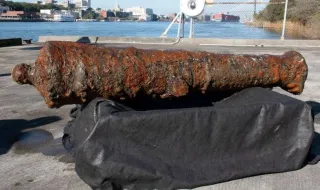
Nineteen Revolutionary War-era cannons were pulled from the Savannah River during dredging operations in 2021 and 2022. Some of the cannons were found with ammunition in their barrels, despite being underwater for nearly 250 years.
The first cannon was found in February 2021 in the Five Fathom Hole area, not far from the old Fort Jackson. Workers were carrying out work on a $973 million project to deepen the ship channel. Since the first find, more cannons, anchors, cleats and parts of a ship's bell have been pulled from the river.
Cannons linked to the Siege of Savannah
The artifacts are linked to the British defense of Savannah in September 1779, when British forces sank their own ships and transports to block the path of the French fleet sent to aid the American forces. The ships likely included the HMS Savannah and HMS Venus, but the origin of the cannons has not yet been definitively established.
„Historical evidence from the time suggests that the ships were sunk so quickly that everything on board was left behind – "weapons, provisions and other equipment," said Andrea Farmer, an archaeologist with the U.S. Army Corps of Engineers.
On October 9, 1779, American and French troops attacked British positions near the Spring Hill redoubt. In the first hour, the Allies suffered about 800 casualties, more than 700 of whom were American or French. The Polish commander, Casimir Pulaski, was mortally wounded. The siege ended on October 18, when General Benjamin Lincoln withdrew his troops.
14 cannons were loaded
Experts have determined that 14 of the 17 cannons examined contained wooden plugs, paper and powder packets, as well as cannonballs. At least four of the cannons are about 178 centimeters long and were probably made in France. The remaining 15 are about 152 centimeters long. They were cast in the mid-18th century, and analysis indicates that they were used at the end of the same century.
Before the restoration, the metal was covered with a thick layer of mussels, shells and other deposits. The guns were stored in water tanks to prevent damage from exposure to air.
Three years of restoration in Texas
In February 2023, 17 guns were sent to the Texas A&M University Conservation Research Laboratory. The team extracted salts from the metal using an electric current, made 3D models and analyzed the composition of the cannons with X-ray fluorescence analysis.
After more than three years of work, 17 cannons have been returned to Savannah and are included in the “Loyalists and Freedom” exhibit at the city’s History Museum. The other two are displayed without restoration, as they were pulled from the riverbed.
“Everyone knows about Lexington and Concord, Valley Forge and Yorktown. But Savannah also played a role, and now we can not only talk about it, but see the events with our own eyes,“ said Nora Fleming Lee, executive director of the Coastal Heritage Society.
Sources: smithsonianmag.com, apnews.com