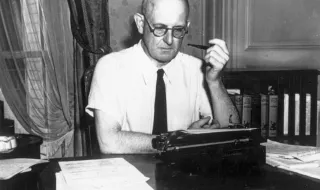
In the world of P. G. Wodehouse, an ordinary morning is rarely ordinary. Someone is engaged to the wrong person, someone has made a promise they can't keep, an aunt threatens to ruin her nephew's life, and at Blandings Castle, a pig may turn out to be the most important figure in the neighborhood. Amidst this seemingly light chaos, Jeeves always appears - calm, resourceful, and almost imperturbable.
Pelham Grenville Wodehouse was born on October 15, 1881, in Guildford, Surrey. Those close to him called him “Plum“ – a nickname that became the writer's unofficial name. He studied at Dulwich College, where he edited the school magazine and played cricket. His first novel was published in 1902, when he was 21 years old.
From the Bank Clerk to Jeeves
Before literature made him famous, Wodehouse worked in a bank. Soon, however, his journalism and short stories began to bring enough income to leave the service. Over the next 70 years, he built a huge body of work - 70 novels, over 300 short stories, at least 20 plays and lyrics for over 200 songs.
His most popular characters appear in the stories about Bertie Wooster - a wealthy, well-intentioned and often helpless young aristocrat, and his servant Jeeves. Bertie usually gets into trouble because of his own decisions, while Jeeves finds a way out with intelligence, tact and extremely precise language. The first story about Jeeves was published in 1916.
The character's name is taken from Percy Jeeves, an English cricketer who died in the First World War. In the books, however, Jeeves does not hold a bat, but manages complex social situations in which his employer regularly finds himself up to his neck in trouble.
Blandings, Hollywood and life between two continents
Another great world in Wodehouse's prose is Blandings Castle. There, Lord Emsworth worries more about his pig, the Empress, than about the family intrigues, engagements and financial problems that constantly invade the estate. Wodehouse also wrote about golfers, school adventures, American millionaires and theatrical heroes.
In the 1930s he worked briefly as a screenwriter in Hollywood. He lived for a long time between Britain, France and the United States, and after World War II he finally settled in America.
The war years left a controversial page in his biography. In 1940, Wodehouse was interned in France after the German invasion. Later he made several radio broadcasts from Germany intended for the American audience. They provoked sharp criticism in Britain and cast a shadow over his name, although they did not interrupt his literary work.
„I don't know what I would do if I wasn't writing“
In an interview with the magazine „The New Yorker“ Wodehouse said: “I love writing, and enough people still do.“ There is his characteristic self-irony in his words. He does not present writing as a solemn vocation, but as an everyday job that he continues to do with pleasure.
Wodehouse died on February 14, 1975, at the age of 93, just a few weeks after being knighted. He remains the author of books in which love, snobbery, friendship and family wars collide with the lightness of farce. That is why his humor does not age easily: the world changes, but the man who gets himself involved in chaos and then seeks out Jeeves remains an eternal literary hero.
Sources: theguardian.com, newyorker.com