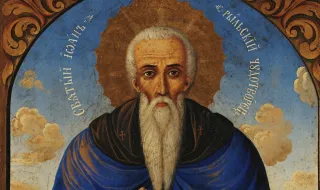
Before becoming the most revered Bulgarian saint, Ivan Rilski was a shepherd from the small village of Skrino. Born around 876, he grew up at a time when Christianity had already been adopted in Bulgaria, but the new faith was still building its spiritual centers. Until the age of about 25, he took care of flocks, and then left worldly life and accepted monasticism.
Ivan's monastic path did not begin directly in Rila. According to his life, he first entered a monastery, but later chose complete solitude. He withdrew to the mountains and lived in harsh conditions, and gradually people seeking spiritual guidance gathered around him. Thus, the lonely hermit became the founder of a community from which the Rila Monastery grew.
The Tsar Travels More Than 120 Kilometers
One of the most famous meetings in the life is that between Ivan Rilski and Tsar Peter I. According to tradition, the ruler traveled more than 120 kilometers to see the hermit. However, the saint did not meet him in a palace or in a richly decorated temple, but from a distance. The story is presented as an example of the special authority that Ivan Rilski acquired during his lifetime.
Folk legends also emphasize his attitude towards wealth. In one of them, the king sends the hermit fruit and gold. Ivan accepts the food, but returns the gold with the words: “I accept the fruit because it is food for the body, but I return the gold because it is poison for the soul.“ This story belongs to folk tradition, not to a reliably established documentary account of the meeting.
„The Testament“ is the most personal trace
Ivan Rilski (also found in church and historical literature as John of Rilski) is not known only through his life and the miracles attributed to his relics. He also left a written text called „The Testament“, addressed to his disciples. In it he speaks of monastic life, humility, work, brotherly love and the danger of striving for wealth and power.
According to BNT, four copies of „The Testament“ are known, one of which is kept in the museum of the Rila Monastery. The Bulgarian Orthodox Church defines it as the only direct written testimony related to the saint that has reached us: “The only thing left of the saint is his Testament.“
His relics travel for nearly five centuries
Ivan of Rila died in 946 and was initially buried at the monastery he founded. Around 980, his relics were transferred to Sredets, present-day Sofia. In 1183, the troops of the Hungarian King Béla III took them to Hungary, and four years later they were returned.
In 1195, Tsar Ivan Asen I transferred the relics to Veliko Tarnovo. They remained there until 1469, when monks returned them to the Rila Monastery. The memory of this event is celebrated on July 1, while October 19 is the day of the saint's Dormition.
Therefore, the image of Ivan Rilski is both historical and legendary. Behind the stories of miracles stands a man who began his life as a shepherd, chose the cave over wealth, and left his followers a brief but lasting spiritual guide.
Sources: bntnews.bg, bnr.bg