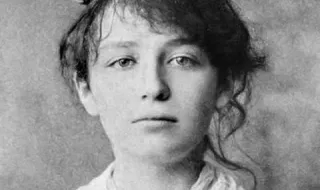
In Camille Claudel's studio, clay is not just a material. It is a way to argue with the world. At the end of the 19th century, when women in France still did not have access to the ´cole des Beaux-Arts, Claudel chose sculpture as a profession and went to Paris to study at the „Colarossi“ academy. There she met Auguste Rodin, but her story does not begin and end with him.
Claudel was born on December 8, 1864 in Fer-en-Tardenois. As a child, she modeled figures from local clay. The sculptor Alfred Boucher noticed her talent and encouraged the family to move to Paris. Boucher later introduced her to Rodin, who attracted her to his studio.
Not only a model and muse for Rodin
Claudel was Rodin's collaborator, model, and lover. She worked alongside him, but gradually sought to free herself from the role of his student. Her exact contribution to individual parts of his works, including “The Gates of Hell“, is not fully established. The “Rodin“ Museum notes that she probably performed intricate details such as hands and feet, but the specific tasks remain uncertain.
Claudel herself created works that are difficult to reduce to Rodin's influence. In “The Gossip Girls“ she captures a brief conversation between women, and in “The Wave“ uses onyx marble, polychromy and a composition influenced by Japanese art and Hokusai. The sculpture is among the clearest signs of her interest in the new artistic trends of the era.
„The Waltz“ and the rejected commission
One of the most surprising episodes is related to „The Waltz“. The first version shows completely naked dancing figures. In 1892, Claudel applied for a state commission for a marble version, but the inspector of arts rejected the project in this form. She added drapery to meet the requirements, but the commission was never fulfilled. She later made new versions in different materials.
In 1895, Claudel received her first commission from the French state for „Maturity“. The work, often interpreted as an allegory of her separation from Rodin, was exhibited in 1899, but the state did not commission a bronze cast. The first bronze was made in 1902, commissioned by Captain Tissier.
The last 30 years
After 1911, financial difficulties, isolation and a severe personal crisis deepened. Claudel destroyed some of her works. The Camille Claudel Museum preserves a letter from her in which she describes how she threw wax sketches into the fire and smashed the figures with a hammer.
On March 10, 1913, a week after her father's death, Claudel was placed in Ville-Evrard. In September 1914, she was transferred to Montfavet because of the war. She remained there until her death on October 19, 1943. The last known photograph of the sculptor is from 1929, when her friend Jessie Lipscomb and her husband William Elborn visited her. "It's a tragic story, but it's hard to judge it today," curator Cecile Bertrand told the Guardian.
Claudel was initially buried in the Montfave cemetery, but her remains were later moved to a common grave. For decades, her name was mostly associated with Rodin. Today, about 90 surviving works, the museum in Nogent-sur-Seine and the collection of the Rodin Museum show another picture: Camille Claudel is not just someone's muse, but an author with his own language, his own courage and his own price paid for the right to be a sculptor.
Sources: theguardian.com, lemonde.fr