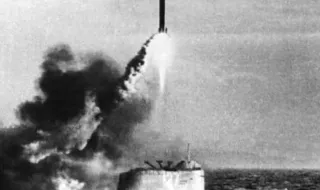
On October 20, 1961, the Soviet Union carried out a test launch that changed the history of underwater nuclear weapons. A R-13 ballistic missile with an operational thermonuclear warhead was launched from the K-102 submarine, formerly known as the B-121 and built under Project 629. The explosion was recorded at the Novaya Zemlya test site as part of Operation “Rainbow“.
The R-13 is a single-stage liquid-fueled missile developed for the D-2 complex. Its range is about 600 kilometers, and the warhead is estimated at approximately 1 megaton. The Federation of American Scientists states that the system is intended for Project 629 submarines and Project 658 nuclear submarines.
The date is often presented as the beginning of submarine ballistic missile launches. However, the first such launch was carried out by the USSR on September 16, 1955, when the R-11FM missile was launched from the B-67 submarine. The launch took place from a surface position.
The same applies to the R-13. The Project 629 submarines had to surface, and the missile had to be raised to a starting position before launch. NASA's historical overview notes: “The R-13 missiles are launched from a surface position.“
The first nuclear warhead from a submarine
The significance of October 20, 1961 is different. Then, for the first time, the USSR tested a ballistic missile with a real thermonuclear warhead from a submarine. The R-13 was aimed at a test site on Novaya Zemlya, and the operation demonstrated that a submarine carrier could deliver a nuclear weapon to a distant target.
The launch took place at the height of the Cold War and just ten days before the test of the Soviet “Tsar Bomb“ on October 30, 1961. Thus, in the autumn of that year, Moscow demonstrated two different possibilities for its nuclear arsenal: a huge power in an atmospheric test and a mobile sea-based carrier capable of approaching a target beyond the range of ground observation.
The transition to underwater launch
The R-13 remains an important but intermediate step in the development of Soviet submarine missiles. The real advantage of the submarine carrier is the ability to remain hidden underwater while launching the missile. This was achieved with the D-4 complex and the R-21 missile. The first successful Soviet launch from a submerged submarine was carried out on September 10, 1960, and the D-4 system entered service in May 1963.
Thus, the R-13 test of October 20, 1961, was not the first launch of a ballistic missile from a submarine, but it was the first Soviet test of a submarine-based ballistic missile with an operational thermonuclear warhead. This is what makes it a key episode in the arms race.
Sources: nuke.fas.org, nasa.gov