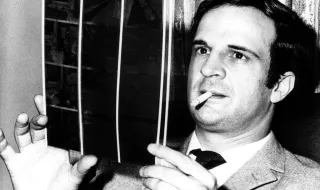
When in 1968 he finally discovered his biological father, François Truffaut went to his house, waited for him and saw him. But he did not introduce himself. Instead, he spent the evening at the cinema, where he watched Charlie Chaplin's “The Gold Rush“. The incident sounds like a scene from his film, but it is part of the life of the director, who died on October 21, 1984 at the age of 52 from a brain tumor.
Cinema instead of school, home and almost everything else
Truffaut was born on February 6, 1932 in Paris and until the age of ten was raised mainly by his grandmother. When he was left without her, he lived with his mother and stepfather. He later described his childhood not as a history of physical abuse, but as a time when he felt “unloved or simply neglected“.
His answer to this loneliness was cinema. As a student, he regularly skipped classes to watch films in small Parisian cinemas, including morning screenings. He watched some titles 14 or 15 times. He recorded three films a day and three books a week in his diary. Later, he himself said that he first wanted to be a writer, then a film critic, and finally decided to make films.
His obsession also had very practical consequences. When he founded a film club, he accumulated debts and at the age of 16 he stole a typewriter from his father's workplace to pay the bills. For the theft, he was taken to the police and sent to a Paris juvenile detention center. Film critic André Bazin intervened to secure his release and helped him get started.
A Man of Extremes
Truffaut was not just a die-hard film buff, but a man who often went to extremes. After being arrested for desertion from the army, he attempted suicide. He later turned the painful experiences of his youth into the basis of “The Four Hundred Blows“ - the film that in 1959 made him one of the symbols of the French New Wave.
He was also unusually secretive. At the same time, he collected almost everything that came into his hands - movie tickets, journalistic passes, casting notes and letters. This passion for archiving coexisted with his inability to master the English language. Despite repeated courses, he never learned it well, which complicated his work on “Fahrenheit 451“.
His personal life was also marked by extremes. Truffaut had relationships with a number of actresses, including Jeanne Moreau, Catherine Deneuve, Jacqueline Bisset, Isabelle Adjani and Fanny Ardant. What is remarkable is that he often maintained a deep closeness with them even after the end of their love affairs. He was both shy and persistent, romantic and obsessive - qualities that he also transferred to his characters.
He turned his life into a film
The strangest thing about Truffaut is perhaps that he hardly separated his life from the cinema. His childhood became material for Antoine Doinel, his friendships - for the characters, and his loves - for entire plots. That's why his films seem personal, without being just a diary.
Truffaut left behind 21 feature films and a reputation built on contradiction: he was a fierce critic of old French cinema, but as a director he gradually replaced aggression with generosity. In his case, oddities are not an adornment of character, but the engine that takes him from the Parisian cinemas to the history of world cinema.
Sources: tcm.com, newyorker.com, criterion.com