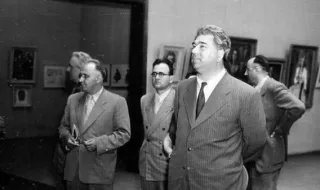
On October 21, 1980, Valko Chervenkov died in Sofia - the man who led the Bulgarian government for six years and simultaneously headed the Bulgarian Communist Party in the early 1950s. He was born on September 6, 1900 in Zlatitsa. His story began as an illegal communist activist and ended as a politician expelled from his own party.
From the September Uprising to Moscow
Chervenkov participated in the September Uprising in 1923. After the attack on the church “St. Nedelya“ and the subsequent repressions in 1925, he was sentenced to death in absentia and left for the Soviet Union. There he worked in the Comintern - the international organization of communist parties - and became involved in the leadership of the Bulgarian communist emigration.
In the USSR, Chervenkov found himself close to Georgi Dimitrov, whose sister Elena later became his wife. In 1944, he returned to Bulgaria and quickly occupied high positions in the new party and state leadership. In February 1945, he was elected a member of the Politburo of the Central Committee of the Bulgarian Communist Party.
Head of the party and government
After the death of Georgi Dimitrov in 1949, Chervenkov became the leading figure in the Bulgarian Communist Party. From 1950 to 1954 he was the General Secretary of the Party, and from February 1950 to April 1956 he was the Prime Minister of Bulgaria. During this period, the state followed the Soviet Stalinist model - accelerated industrialization, collectivization of agriculture and highly centralized management.
During his time, Bulgaria joined the Warsaw Pact in 1955. The construction of large industrial and infrastructure facilities began, but economic changes went hand in hand with restrictions on political opponents, pressure on society and persecution of dissidents. State security and legal trials were part of the mechanism through which the government consolidated the regime.
Chervenkov's name is also associated with a cult of personality, modeled after that of Joseph Stalin. At the April Plenum of the Central Committee of the Bulgarian Communist Party in 1956, he himself admitted:
„My fault is that I honestly and sincerely had a deep conviction [...] to affirm my cult.“
The Removal and the Last Years
After Stalin's death and the de-Stalinization that began in the USSR, Chervenkov's positions weakened. At the April Plenum, the cult of his personality was condemned, and in April 1956 he was dismissed from the post of Prime Minister. Anton Yugov became the head of the government. Chervenkov remained in the Politburo and became Deputy Chairman of the Council of Ministers, but his influence gradually diminished.
In 1957-1958, he headed the Ministry of Public Education and Culture. In November 1961, he was removed from the Politburo, and a year later he was expelled from the Bulgarian Communist Party and removed from the Central Committee. His membership was restored in 1969, without him returning to the first ranks of power.
Vulko Chervenkov died on October 21, 1980. He remains in history both as one of the architects of the Stalinization of Bulgaria and as a politician whose removal marked the beginning of a new stage in the governance of the communist state.
Sources: old-news.bnr.bg, archives.bnr.bg, 24plovdiv.bg