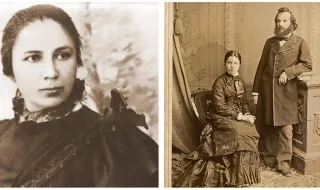
When Ekaterina Peneva married Petko Karavelov in 1880, she already had an education received in Moscow and experience as a teacher behind her. The marriage took her to the center of political life, but did not turn her into anyone's shadow. In the following decades, she built her own public presence - as an educator, translator, writer and defender of women's rights.
Ekaterina Karavelova was born on October 21, 1860 in Ruse. At the age of ten, she left for Russia, where in 1878 she graduated from the IV Moscow Women's Gymnasium with a gold medal. After returning to Bulgaria, she taught in Ruse, Plovdiv and Sofia. By 1903, she worked at school for a total of 14 years, insisting that girls receive not only basic literacy, but also the opportunity for professional and higher education.
From the classroom to public life
On January 13, 1880, she married Petko Karavelov in the Ruse church “Holy Trinity“. The family had three daughters – Radka, Viola and Lora. Politicians, writers and public figures met in the Karavelov home, and Ekaterina gradually became an independent figure with influence far beyond the family circle.
For more than 20 years, she led the general education women's society “Maika“ and participated in the development of the girls' vocational school “Maria Luiza“. In 1901, she was among the founders of the Bulgarian Women's Union – an organization that unites women's societies from the country and puts the education, professional realization and civic participation of women on the public agenda. From 1915 to 1925, Karavelova was the vice-chairwoman of the union.
Translator, peacemaker and advocate
Karavelova also worked with literature. She translated authors such as Leo Tolstoy, Fyodor Dostoevsky, Victor Hugo, Guy de Maupassant, Gustave Flaubert and Charles Dickens. She wrote political feuilletons, articles and literary criticism, and her command of several languages allowed her to present Bulgarian causes to an international audience.
During the Balkan Wars, she worked as the chief sister of mercy at the Military School. Later, she headed the Bulgarian section of the Women's International League for Peace and Freedom and represented the country at international forums in Washington and Dublin. For her, peace is not just the absence of fighting, but a social order based on rights and democracy. At the Dublin congress, she formulated her position as follows: “Our ideal is not the peace that governments conclude without knowing the real aspirations of the peoples, but the peace of true democracy.“
“I did what any woman would do“
One of the most dramatic episodes in her life is related to the imprisonment of Petko Karavelov and other political figures at the end of the 19th century. Ekaterina Karavelova turned to foreign diplomatic representatives to signal the attitude towards the arrested. For this, she was placed under house arrest and stood trial on charges of treason.
In her last words, she declared: “I did what any woman in my place would do for her husband.“ The sentence was not carried out, and the incident remains one of the most frequently told examples of her character - her personal loyalty went hand in hand with the belief that power must be held accountable.
After her husband's death in 1903, Karavelova continued her public work. In 1935, she headed a delegation that insisted on the abolition of death sentences for political prisoners, and her participation in initiatives to protect persecuted people complemented her image as a consistent defender of human dignity. Ekaterina Karavelova died on April 1, 1947 in Sofia, but her name remains associated with one of the important questions of Bulgarian history: how a woman can turn education and personal courage into a social force.
Sources: bta.bg, old-news.bnr.bg