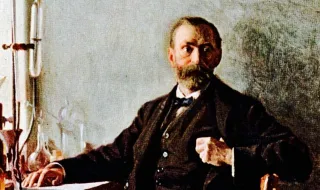
When Alfred Nobel was born on October 21, 1833 in Stockholm, his family was already facing financial collapse. His father, Immanuel Nobel, went bankrupt the year his son was born, and a few years later he left for St. Petersburg. There he created a mechanical workshop and managed to build a new enterprise that also produced military materials.
Alfred spent much of his childhood and youth in the Russian capital. At the age of 17, he spoke five languages fluently. He was sent to learn about chemistry and industry in Europe and the United States, but his interests were not limited to science. Even as a young man, he wrote poems and plays, and later collected a library of over 1,500 volumes. For him, literature was not a leisure activity, but a way to reflect on loneliness, love and the meaning of life.
The invention that began with tragedy
Nobel began working with nitroglycerin in the early 1860s. In 1863, he received his first patent related to the industrial use of the dangerous substance. A year later, an explosion in a laboratory near Stockholm took the life of his younger brother Emil.
The tragedy did not stop his research. On the contrary, it directed Nobel to the search for a safer way to work with nitroglycerin. After an explosion that destroyed his factory near Hamburg in 1866, he continued his experiments on a raft anchored in the Elbe River. There he discovered that diatomaceous earth could turn liquid nitroglycerin into a more stable paste. Thus, dynamite appeared.
The name comes from the ancient Greek word “dynamis“ – “force“. Dynamite is not TNT, as is often believed, but a stabilized form of nitroglycerin. The patent was issued in 1867, and the invention quickly found application in the construction of tunnels, railways and canals, but also in the military industry. Within a decade, factories were set up in 14 countries around Nobel's inventions.
Lesser-known inventions
Dynamite is only the most famous result of Nobel's work. In 1875, in his laboratory in Paris, he created explosive gelatin – a material that combined greater power with better resistance. Later, he also developed ballistite – smokeless gunpowder, which brought him into serious dispute with the French authorities. His 355 patents also covered ideas for synthetic rubber, artificial silk, fuels and various chemical products.
Nobel was both an inventor, an entrepreneur and a man who traveled constantly between his enterprises. He himself described his lifestyle with the words: “Home is where I work, and I work everywhere.“ In 1891 he left Paris and settled in San Remo, Italy, where he continued to work in his private laboratory.
Bertha von Suttner and the will
In 1876, Nobel briefly hired Bertha Kinski as his housekeeper and personal secretary. She soon left to get married, but the two maintained their correspondence. Bertha von Suttner later became one of the most prominent peace activists in Europe and in 1905 received the Nobel Peace Prize.
On November 27, 1895, Nobel signed his last will and testament in Paris. In it, he determined that the majority of his fortune was to be invested in a fund whose funds were to be used to award prizes for contributions to physics, chemistry, physiology or medicine, literature, and peace. He died on December 10, 1896 in San Remo, without seeing the first award ceremony. It took place in 1901 - five years after his death.
Sources: history.com, nationalgeographic.com, apnews.com