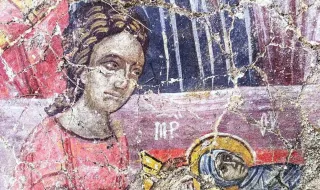
Underground in the historical quarter "Armenia" in Melnik, a scene from a medieval mural created in the 13th–14th centuries has been preserved. The fragment was discovered during the excavations of the temple "Holy Virgin Mary, the Life-Giving Source" and is the largest mural from the earlier church discovered so far.
Archaeologists recognize the scene "Nativity of the Virgin Mary" in the image. Mary with a halo, depicted as a baby, is visible. “This is the largest fragment of the medieval murals in the church discovered so far. We have no doubt that this is the scene of the “Nativity of the Virgin“, because Mary with a halo, represented as a baby, is clearly visible,“ commented the head of the research, Assoc. Prof. Dr. Metodi Zlatkov, to Bulgaria ON AIR.
The old church existed for more than five centuries
The research is led by Assoc. Prof. Dr. Metodi Zlatkov from the National Archaeological Institute with Museum at the Bulgarian Academy of Sciences and Dr. Maria Pashova from the Regional Historical Museum in Blagoevgrad. They trace the history of a temple that preceded the Bulgarian Renaissance church.
The medieval building was about 17 meters long and 5.50 meters wide. It existed for more than five centuries before, in the mid-19th century, the locals demolished it and built a larger temple 33 meters long in its place.
During the demolition, some of the frescoes fell from the walls. The locals collected the fragments and transferred them to the altar of the new church. Thus, images of human figures and architectural details have survived to this day, including the scene of the “Nativity of the Virgin“.
The fragments will be restored
At the end of the 19th century, the French researcher Paul Perdrissé described the frescoes in Melnik as some of the best of their time. After the First World War and the depopulation of the city, a large part of the artistic heritage was considered lost.
Archaeological research will continue. The team expects that it will take another season or two to fully explore the church and the surrounding area. After that, the discovered fragments will undergo restoration and conservation, and the plan is to display them in the Melnik museum.
The upcoming exhibition could turn the medieval church and its frescoes into a new highlight for cultural tourism in the city, but access to the archaeological site itself will depend on its future socialization.
Sources: plovdiv24.bg, bgonair.bg