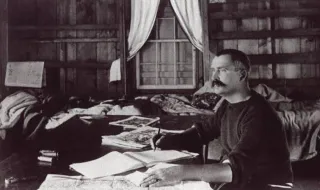
Before writing "The Headless Horseman", Mayne Reed had already lived a life that could easily be the plot of an adventure novel. He was born on April 4, 1818 in Ballyronie, County Down, Ireland, to a Presbyterian minister. He was prepared for a clerical career, but chose a different path. In 1839, he left for the United States, where he changed several professions - teacher, salesman, journalist and actor.
In 1843, Mayne Reed settled in Philadelphia and began working as a journalist. There he met Edgar Allan Poe. Poe later described him as a “colossal but extremely picturesque liar“, but his words were not just a mockery. In the same sentence, he acknowledged that Reed told his stories with a scale and artistry that made him listen attentively.
From the battlefield to the pages
When the Mexican-American War began, Reed did not remain an observer. In 1846, he joined the First New York Volunteer Infantry Regiment, and in January 1847 he left for Mexico. On September 13 of that year, he was seriously wounded in the thigh during the storming of Chapultepec Castle near Mexico City. During the war, he sent correspondence and descriptions of the battles, and his experiences later became the basis for his literary work.
After returning to Europe, Maine Reed turned to literature. His first novel, "The Riflemen," was published in 1850. It was followed by "Scalp Hunters," "The Desert Home," "Boy Hunters," "The White Chief," "Occeola," and "The Quarter Horse." These books feature prairies, deserts, hunters, soldiers, and Native American tribes, but also an interest in nature, animals, and the lives of people on the frontier of the expanding United States.
The Story Behind "The Headless Horseman"
The "Headless Horseman" remains most memorable to readers. The novel was originally published in parts in 1865-1866 and is related to a folkloric story from South Texas. The main character transforms the landscape of the American Southwest into a place of mystery, persecution and danger. The book is among the works with which Mayne Reed gained international popularity.
The writer did not only create novels for adults. Books such as “The Desert Home“ and “The Boy Hunters“ were intended for young readers and combined adventure with descriptions of animals, plants and distant lands. Thus, Mayne Reed became one of the authors through whom generations of readers first imagined the American prairie and life beyond the familiar horizon.
His last years were marked by health problems related to an old war injury. Mayne Reed died on October 22, 1883 in London, at the age of 65, and was buried in Kensal Green Cemetery. What remains is a writer whose life and books meet at the same point – in both cases the adventure begins where the quiet road ends.
Sources: irishnews.com, utroruse.com