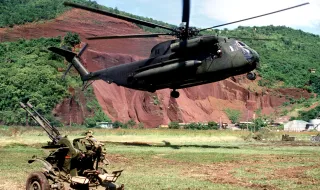
On October 25, 1983, the United States and six Caribbean countries launched the military operation “Urgent Fury“ against Grenada. The invasion came days after the assassination of Prime Minister Maurice Bishop and the overthrow of his government by a radical military wing of the ruling People's Revolutionary Movement.
In addition to the United States, the coalition includes Antigua and Barbuda, Barbados, Dominica, Jamaica, Saint Lucia, and Saint Vincent and the Grenadines. According to a statement from President Ronald Reagan at the time, Washington had received a formal request for intervention from the Organization of Eastern Caribbean States.
The Pre-Invasion Crisis
Grenada had been ruled by Maurice Bishop since the 1979 revolution that brought the leftist People's Revolutionary Movement to power. In early October 1983, internal conflict within the leadership escalated. Bishop was removed from power and executed on October 19 along with other government officials.
After his assassination, a Revolutionary Military Council, headed by General Hudson Austin, took control. The United States said the situation threatened the approximately 800 American medical students and other citizens on the island. Reagan stated that the operation was undertaken "to protect innocent lives," to restore order and democracy, and to prevent a Cuban presence on the island.
Fighting and casualties
The American forces clashed with Grenadian army units and Cuban soldiers and construction workers engaged in the construction of a new airport. The number of American and Caribbean soldiers involved in the operation reached approximately 7,600.
The fighting continued for several days. American losses were 19 killed and 119 wounded. Cuban forces suffered 59 killed and 25 wounded. Casualties among Grenadian soldiers and civilians vary by source, with dozens reported. On 2 November, the armed conflict ended and the military government was removed.
International reaction and consequences
The invasion provoked sharp criticism, including from Britain, which was not informed of the operation in advance. On 2 November 1983, the UN General Assembly adopted a resolution "deeply condemning" the armed intervention as a violation of international law. The vote was 108 votes "for", 9 "against", and 27 abstentions. Among those who voted against were the United States and several Caribbean countries that had participated in the operation.
After the fighting ended, an interim government was established on the island, and American combat troops withdrew by December 15, 1983. In December 1984, Grenada held its first democratic elections since the revolution and invasion. The operation remains one of the most controversial American military actions in the Caribbean during the Cold War: Washington defined it as a rescue mission, while the United Nations General Assembly qualified it as an illegal armed intervention.
Sources: history.com, cgi.pbs.org, washingtonpost.com