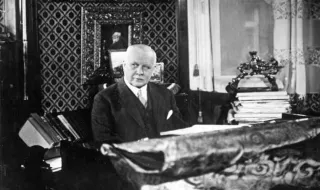
In a villa on the Traun River, far from the noisy Viennese stage, Franz Lehár spent almost every summer from 1912 until his death. It was there that the composer, born in Komárom in 1870, loved to work and repeated: "I always have the best ideas in Ischl."
Lehár died on October 24, 1948 in Bad Ischl, Austria, at the age of 78. Two decades earlier, his name had already traveled the world thanks to "The Merry Widow" – the operetta that transformed the waltz and melodic lightness into an international theatrical phenomenon.
From the military orchestra to the Viennese stage
Music had been a part of his life since childhood. His father, Franz Lehár Sr., was a military bandmaster in the Austro-Hungarian army and a composer of marches and dance music. The young Lehár studied violin, theory and composition at the Prague Conservatory. There he received encouragement from Antonín Dvořák to focus on composition rather than remaining just a performer.
His first professional years were spent as a violinist and military conductor. This work took him through various parts of Austria-Hungary and gave him a first-hand experience of the musical traditions of Central and Eastern Europe. His first opera was “The Cuckoo“, staged in 1896 and later revised as “Tatiana“.
Premiere with low expectations
“The Merry Widow“ was staged in Vienna on December 30, 1905. At first, the theater did not expect great success, and the production was realized with modest sets and worn costumes. This did not prevent the work from becoming one of the most famous operettas of the 20th century.
Lehar created about 30 operettas. Among them are "The Count of Luxembourg", "Gypsy Love", "Eva", "Paganini", "Land of Smiles", "The Tsarevich" and "Giudice". His music is not limited to waltzes. It is influenced by Puccini, Richard Strauss and Debussy, and the orchestration is often richer and more dramatic than expected for the genre.
Love, Protection and Moral Complexity
Lehár met Sophie Mett in Bad Ischl. The two lived together for years before marrying in 1924. Sophie was Jewish, and after the Nazis came to power, her background put the family in danger. According to BR-KLASSIK, Lehár personally intervened with Adolf Hitler to protect her and helped her brother leave Europe.
This side of his life existed alongside the fact that Lehár maintained relations with the Nazi regime. As the “Berliner Zeitung“ notes, in 1939 and 1940 he received awards from Hitler, and his works were performed in versions adapted to the regime. His wife was granted a special status that protected her from persecution.
In 1912, the composer bought the villa in Bad Ischl for approximately 68,000 crowns. In his will, he left it to the city to be converted into a museum. Today, the preserved furniture, paintings and personal belongings reveal not only the author of “The Merry Widow“, but also the man who sought silence by the river to write his next melody.
Sources: br-klassik.de, berliner-zeitung.de, paperspast.natlib.govt.nz