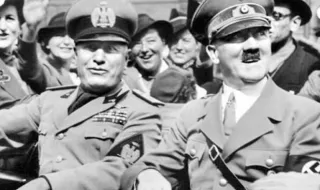
On October 25, 1936, Adolf Hitler and Benito Mussolini signed a treaty of friendship and political cooperation between Nazi Germany and Fascist Italy. The agreement marked the beginning of the Rome-Berlin Axis - a rapprochement that a few years later would develop into a military alliance and would link the two countries with Japan in World War II.
According to the agreements, Berlin and Rome embarked on a course to coordinate their foreign policies. The two governments sought to establish a common front on key European issues and to limit the influence of democratic states and the League of Nations.
From sanctions on Ethiopia to rapprochement with Berlin
By the beginning of 1936, Mussolini's Italy was in severe diplomatic isolation. In 1935, the Italian army invaded Ethiopia, then known as Abyssinia. The League of Nations condemned the aggression and imposed economic sanctions on Rome.
The sanctions did not stop the conquest, but they worsened Italy's relations with Britain and France. Germany used the moment to get closer to Mussolini and support the Italian position. Thus, the two regimes, which had previously had differences on a number of issues, began to see in their partnership a way out of international isolation.
The Spanish Civil War provided an additional impetus. In 1936, Hitler and Mussolini sided with Francisco Franco's forces, while the Soviet Union supported the Republican government. Spain became a battleground for ideologies and a practical opportunity for Berlin and Rome to act together.
Mussolini gave the new alliance a name
The agreement of 25 October itself was not officially called the "Rome-Berlin Axis". It was ratified a few days later. In a speech in Milan on 1 November 1936, Mussolini declared that the relationship between the two countries constituted "an axis around which all European countries, filled with a desire for peace, can cooperate".
The formulation was presented as peaceful, but behind it lay the claim that Germany and Italy would have a decisive role in European politics. Historical reference books indicate October 25 as the date of the treaty of friendship, while the Italian encyclopedia Treccani links the creation of the political axis to the Berlin agreements of October 23. The difference concerns the dating of the protocol and the signing, not the historical rapprochement itself.
From political partnership to military alliance
On November 25, 1936, Germany and Japan signed the Anti-Comintern Pact, aimed at opposing the Comintern and Soviet influence. Italy joined in 1937, which expanded the European German-Italian partnership.
On May 22, 1939, Hitler and Mussolini signed the Pact of Steel. It transformed the political rapprochement into a formal military alliance. On September 27, 1940, Germany, Italy, and Japan concluded the Tripartite Pact and formed the core of the Axis powers.
The beginning, set on October 25, 1936, changed the diplomatic landscape in Europe and created the link that would later bind Italy to the war plans of Nazi Germany.
Sources: amp.dw.com, time.com, raicultura.it