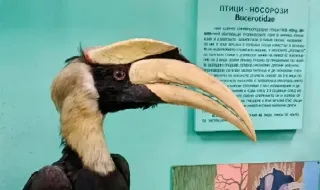
Near Hadzhidimovo, in the Blagoevgrad region, fossil bones of a prehistoric hornbill that lived about 7 million years ago were discovered. The find was named Euroceros bulgaricus and is the first known presence of representatives of the Bucerotidae family in Europe.
The remains date from the Late Miocene – a period in which hornbills had a much wider distribution than today. At that time, their range covered Africa, Europe and Asia. Today, representatives of the family are found in Sub-Saharan Africa and the Indo-Malayan zoogeographic region.
„The find is important evidence of the presence of these birds in Europe during the Neogene“, reports the National Museum of Natural History at the Bulgarian Academy of Sciences.
Hadzhidimovo reveals ancient birdlife
The discovery is part of a series of paleontological finds made and studied in Bulgaria over the past three decades. They show that the Neogene avifauna of today's Bulgarian lands was more diverse than previously thought.
Among the significant finds are fossil snake eagles, Neogene pheasants, as well as the first remains of ostriches, peacocks, swans, falcons and larks found in our country. Ancient ostriches have been found in four localities – near Hadzhidimovo, Kalimantsi, Sarafovo and Stanyantsi. Fragments of eggshells have also been found, which complement the data on their presence in the region.
Traces from different habitats
Fossil birds provide information not only about the species, but also about the environment in which they lived. Climatic changes during the Miocene and Pliocene led to aridification and expansion of grasslands in a number of regions. This changed the habitats and influenced the distribution of birds.
The finds of ostriches, peacocks and hornbills show that during the Neogene, different natural environments existed on the territory of present-day Bulgaria – from open grasslands to forested habitats. Studying the remains allows scientists to reconstruct ancient birdlife and track changes in the natural conditions of the Balkans.
Data on fossil birds have been published in scientific studies in Bulgaria and abroad. New finds and revisions of already described species continue to expand the picture of life in the region millions of years ago.