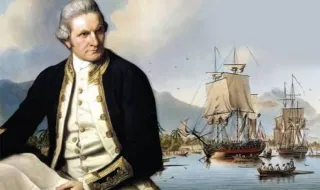
When James Cook set out for the Pacific Ocean, much of the world's maps were still blank. When he died 11 years later, he had marked with unusual accuracy the coasts, islands and sea routes that future generations would sail.
Cook was born on October 27, 1728, according to the Julian calendar then used in England. In today's Gregorian calendar, the date corresponds to November 7. His birthplace was Marton in Yorkshire, and his father was a farm laborer. At the age of 17, Cook began working in merchant shipping, but in 1755 he chose the Royal Navy over the opportunity to command a merchant ship.
Cartographer before explorer
Cook's first great fame came not from distant islands, but from his maps of Newfoundland. Between 1763 and 1766, he explored the coast of the Canadian island and created maps that impressed with their accuracy. The ability to determine the location of the ship and describe unknown coasts proved crucial for his future expeditions.
In 1768, Cook took command of the “Endeavour“ and sailed for Tahiti. The official task was to observe the transit of Venus in front of the Sun. However, he was then ordered to search for the supposed Southern Continent and explore unknown parts of the Pacific Ocean.
Cook circumnavigated New Zealand and proved that it was not part of a larger southern landmass. In 1770, he reached the east coast of Australia and mapped it in detail. He did not “discover” the continent, which had been inhabited by indigenous peoples for millennia, but his voyage was the first systematic British exploration of its eastern coast.
Three voyages and a scientific revolution
During his second circumnavigation, which began in 1772, Cook crossed the Antarctic Circle. The expedition did not reach Antarctica, but it showed how difficult it was to have a large habitable continent in the southern latitudes, surrounded by ice.
Among his most important achievements was his concern for the health of his crew. Cook insisted on cleanliness on board, ventilation, fresh food, and the use of sauerkraut. Although the cause of scurvy was unknown, these measures significantly limited the disease. In the words attributed to Cook himself, his ambition led him "as far as a man can go".
In 1776, he set off on his third voyage with the ships "Resolution" and "Discovery". The goal was to discover the Northwest Passage between the Pacific and Atlantic Oceans. The expedition explored the coasts of North America and Alaska, but ice in the Bering Strait forced Cook to withdraw.
The Last Days in Hawaii
On the return journey, the ships reached the Hawaiian Islands, which Cook called the Sandwich Islands. Initial contact was peaceful, but relations deteriorated when the expedition returned in 1779. A dispute broke out after a ship's boat disappeared.
On 14 February, Cook went ashore at Kealakekua Bay. In the ensuing tension, he and his crew were met by armed natives. Cook was beaten and stabbed, and his body was carried away by the islanders. Some of the remains were later returned to the British.
The expedition continued under the command of Charles Clark, who died during the voyage, and then John Gore. The ships returned to England in 1780. Cook's legacy remains twofold: as a meticulous cartographer and organizer of scientific expeditions, but also as a representative of British imperial expansion. It is this blend of science, seafaring and colonial ambitions that makes its history relevant today.
Sources: rmg.co.uk, history.com, apnews.com