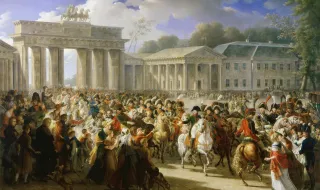
On October 27, 1806, Napoleon Bonaparte solemnly entered Berlin, after the French army defeated the Prussian forces in the double battle of Jena and Auerstedt. The defeat on October 14 left Prussia without an effective defense of the capital and turned the march on Berlin into one of the most visible successes of the Napoleonic Empire.
French units had already reached the city when the emperor arrived in person. At around 3:00 p.m., he passed through the Brandenburg Gate, accompanied by the infantry guards, cavalry units, and marshals Louis-Nicolas Davout and Pierre Augereau. The city authorities, represented by the military governor, General Henri-François Boulainn, handed him the keys to Berlin.
The victor enters the capital
In the 21st bulletin of the Grande Armée, the scene was described as a ceremonial entry. “Yesterday, the 27th, the emperor made a ceremonial entry into Berlin“, the announcement read, adding that the streets were crowded with residents, and that evening the city was illuminated.
However, the picture of a festive welcome does not exhaust the actual situation. The Prussian court had already left the city. King Frederick William III and Queen Louise retreated eastward, while the army broke up into separate groups and headed for fortresses and allied territories.
Historical accounts of the first days of the occupation also show another side to the event. Some Berliners remained at home, and many shops were closed. Napoleon's triumphal entry was a political spectacle, intended to show that Prussia had been defeated and that the French army was in control of its center.
The Quadriga as Spoils of War
The most memorable symbol of victory is the Brandenburg Gate. By order of Napoleon, the Quadriga - the chariot of the goddess of victory Victoria - was taken down, dismantled, and sent to Paris. The statue was presented as a trophy of the defeat of Prussia and remained in France until 1814, when it was returned to Berlin after Napoleon's defeat.
The fall of Berlin did not immediately end the war. On October 28, Prussian General Friedrich von Hohenlohe surrendered at Prenzlau, and in early November, French troops continued to pursue the retreating Prussian units. Gebhard Leberecht von Blücher's forces were defeated at Lübeck on November 7.
From Berlin, Napoleon took his next major political step. On November 21, 1806, he issued the Continental Blockade decree, prohibiting trade between French-controlled countries and Great Britain. Thus, entering the Prussian capital became not only a military triumph, but also the starting point for a new stage in his struggle against British influence in Europe.
Sources: napoleon.org, history.com