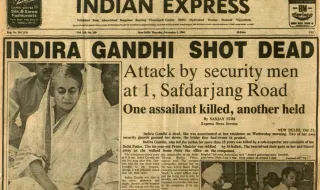
Indira Gandhi walks down the driveway to her office at the Indian Prime Minister's residence in New Delhi. Two security guards, Beant Singh and Satwant Singh, await her at the gate. Both are Sikhs. They open fire on her shortly after 9:30 a.m. on October 31, 1984.
According to eyewitness accounts published by United Press International, Beant Singh fired first with a .38 revolver. Satwant Singh continued the fire with a Sten automatic weapon. Gandhi was seriously injured and taken to the All India Institute of Medical Sciences in New Delhi, but doctors were unable to save her life.
After the attack, the two guards were disarmed and taken to a guardhouse. There, another round of gunfire erupted. Beant Singh was killed, while Satwant Singh survived and was later tried. In 1986, he was sentenced to death, and the sentence was carried out in January 1989.
The assassination came after the Amritsar operation
Just a few months earlier, India had been experiencing one of its worst crises. In June 1984, the army carried out Operation Blue Star in the Golden Temple complex in Amritsar - the holiest site for Sikhs. The aim was to remove armed Sikh separatists who had entrenched themselves in the temple complex. The fighting caused a large number of casualties and extensive damage to the religious shrine.
The operation angered many Sikhs and threats were made against Gandhi. Despite concerns about her safety, Sikh officials were not completely removed from the prime minister's security. According to eyewitness accounts quoted by “Time“, after the shooting, Beant Singh said: “I did what I had to do. Now do what you have to do.“
Assassination unleashes violence
Gandhi's death sparked a wave of anti-Sikh violence in Delhi and other parts of India. A document from the Indian Ministry of Home Affairs states that the attacks in Delhi began on the evening of October 31 and continued until November 7. Sikhs were killed, and their homes and properties were looted and burned. The number of victims remains the subject of various estimates and political disputes.
On the same day, Indira Gandhi's son - Rajiv Gandhi - assumed the post of prime minister. The assassination also led to a complete rethinking of the security of the Indian prime minister. In 1985, the Special Protection Group was created - a special structure directly subordinate to the central government and designed to protect the prime minister and his family.
Indira Gandhi remains one of the most influential and controversial figures in modern Indian history. She was Prime Minister from 1966 to 1977 and from 1980 until her assassination in 1984. The assassination attempt not only marked the end of her political career, but also the beginning of a new, even bloodier phase of the conflict between the Indian state and the Sikh separatist movement.
Sources: history.com, upi.com, time.com